Du Mai (Governing Vessel) Channel
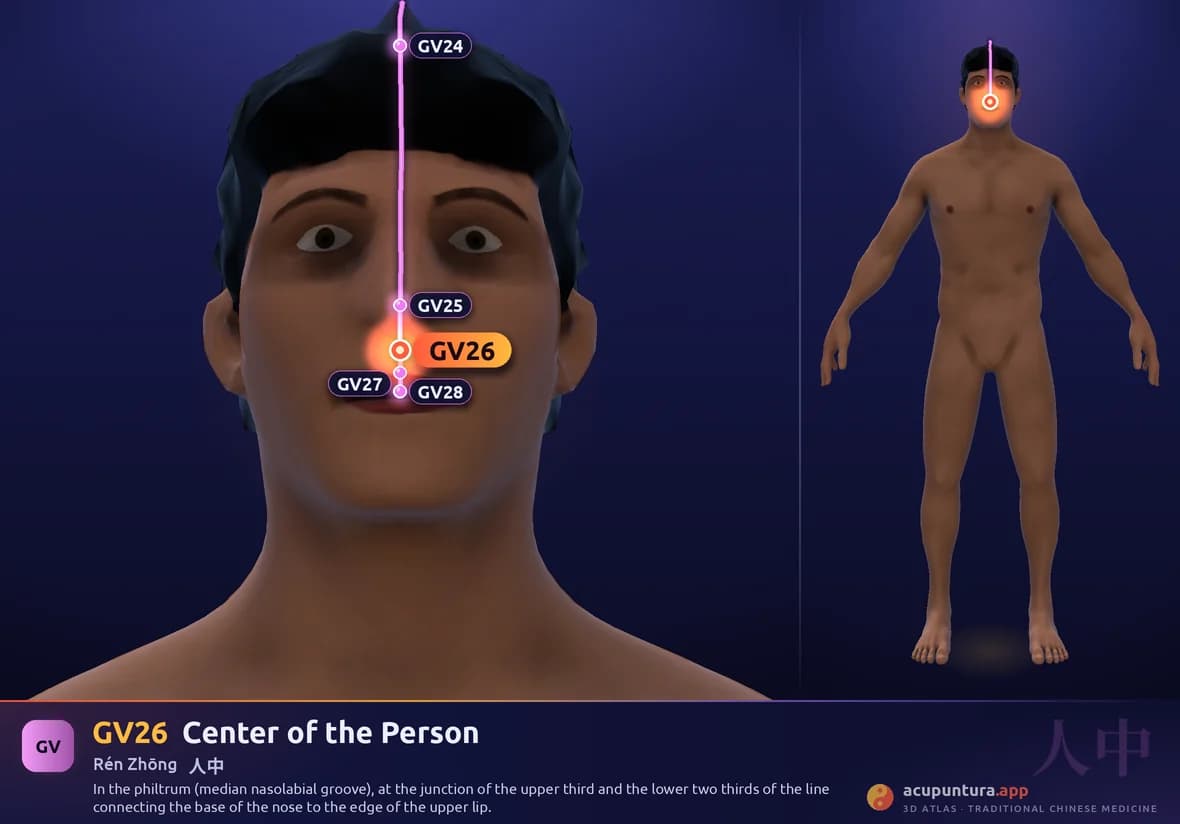
Center of the Person
人中Rén ZhōngAnatomical location
In the philtrum (median nasolabial groove), at the junction of the upper third and the lower two thirds of the line connecting the base of the nose to the edge of the upper lip.
Main function
Restores consciousness, expels Wind, relieves facial pain.
- Crossing point with the Large Intestine and Stomach
Therapeutic indications
- Loss of consciousness
- convulsions
- facial paralysis
- headache
- Shock
- Collapse
- Stroke
- Epilepsy
- Infantile convulsions
- Acute low back pain
- Heatstroke
- Hysterical episodes
- Schizophrenia (Dian Kuang)
- Bipolar disorder (Dian-Kuang alternation)
- Acute psychosis
- Hypotension
Name and classical tradition
Renzhong (人中) has two names with two different histories. The classic name of the point is 水溝, the “water channel,” and that is how the Zhenjiu Jiayi Jing (Systematic Classic of Acupuncture and Moxibustion) records it: «水溝在鼻柱下人中,督脈,手足陽明之會». Shuigou is below the nasal septum, in the renzhong; it is the meeting point of the Du Mai and the Yangming channels of the hand and foot. In that sentence 人中 was the name of the region, the philtrum, and in common usage it ended up prevailing as the name of the point.
水溝 literally describes the groove: 水, water, and 溝, ditch. 人中 is explained by the division of the face into three tiers, heaven, man, and earth: the nose occupies the tier of man, and 中, center, marks the midline. The term is old. The Lingshu (Spiritual Pivot) already uses it in the context of physiognomic diagnosis: «唇厚,人中長,以候小腸», thick lips and a long renzhong make it possible to assess the Small Intestine.
The point also has names from another tradition, that of Sun Simiao's thirteen spirit points, where it holds first place. The Qianjin Yaofang (Essential Prescriptions Worth a Thousand Gold) says to always begin with it, «凡針先從鬼宮起», and defines it: «第一針人中名鬼宮,從左邊下針右邊出», the first needle is Renzhong, called the “palace of the spirits,” inserted on the left and exiting on the right. The reference works add 鬼客廳. In later practice, especially modern practice, Renzhong became the resuscitation point par excellence, a use that rests on clinical tradition rather than on an ancient citation.
Other names
- 鬼宮Qianjin Yaofang