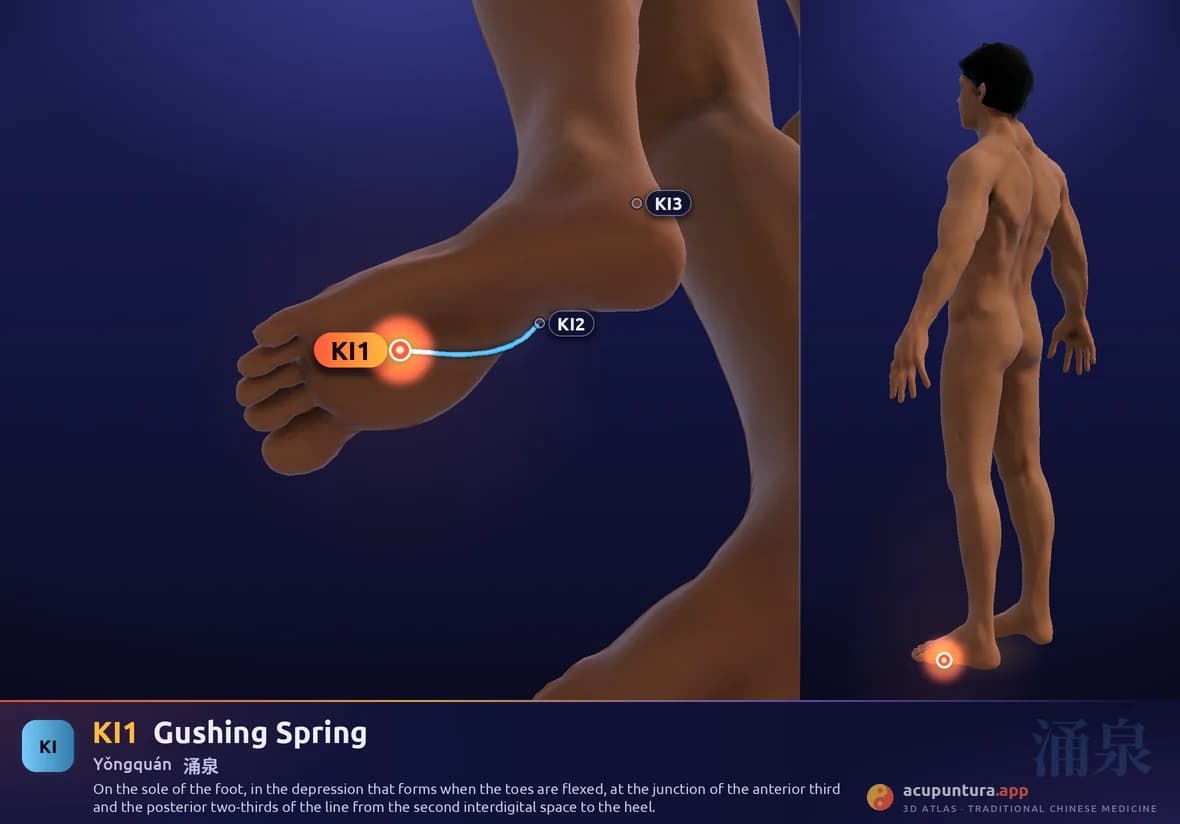
Kidney Channel
Gushing Spring
涌泉YǒngquánAnatomical location
On the sole of the foot, in the depression that forms when the toes are flexed, at the junction of the anterior third and the posterior two-thirds of the line from the second interdigital space to the heel.
Main function
Nourishes Kidney Yin, calms the Shen, tonifies Yang, descends Liver Yang, eliminates Internal Wind, opens the sensory orifices, restores consciousness, benefits the throat, cools the Blood, clears Heat, strengthens the lumbar region, regulates urination, and strengthens willpower.
- Jing-Well point (Wood)
- Sedation Point
- Exit Point
Therapeutic indications
- Headache
- vertigo
- tinnitus
- deafness
- insomnia
- anxiety
- loss of consciousness
- epilepsy
- hypertension
- sore throat
- dry mouth
- enuresis
- urinary incontinence
- low back pain
- leg weakness
- pain in the sole of the foot
- heat in the soles
- night sweats
- afternoon fever
- red tongue without coating
- thin
- rapid pulse
- Heatstroke
- Shock
- Vertex headache
- Dizziness
- Hot flashes
- Dry throat
- Aphonia
- Pain in the sole of the foot
- Infantile convulsions
- Constipation
- Dysuria
- Plantar fasciitis
Ryodoraku
- Sedation of Kidney
Name and classical tradition
Yongquan, 涌泉, is the “gushing spring.” 涌 (湧) means to well up forcefully, to bubble; 泉 is the spring, the fountain. The point is on the sole of the foot, the lowest place on the body, and the image is of water surging from the earth. It is the first point of the Kidney channel, the organ the tradition regards as the root of the body's yin and yang, and its Qi rises here from below like a spring.
The Lingshu (Spiritual Pivot), in the Ben Shu chapter (本輸), opens the channel's sequence with it: “腎出於湧泉……為井木.” Kidney Qi emerges at Yongquan; it is the Jing-Well point, of Wood nature. It is therefore the Well of the Water channel, the only Well point that is not at the tip of a digit. In the circuit of the twelve channels, it receives the Qi that the Bladder hands off at BL67, Zhiyin.
Its alternate names insist on the earth: 地衝, “thrust of the earth,” and 地衢, “crossroads of the earth.” Both allude to its position as the most earthly point of the body. In the Song period it appears recommended in the Su Shen Liangfang (Su and Shen's Good Formulas), a compendium partly attributed to the poet Su Shi, and in the Bianque Xinshu (Bian Que's Heart Book) by Dou Cai, in the context of moxibustion to preserve yang. Those passages have not been rechecked.
Other names
- 地沖Jiayi Jing