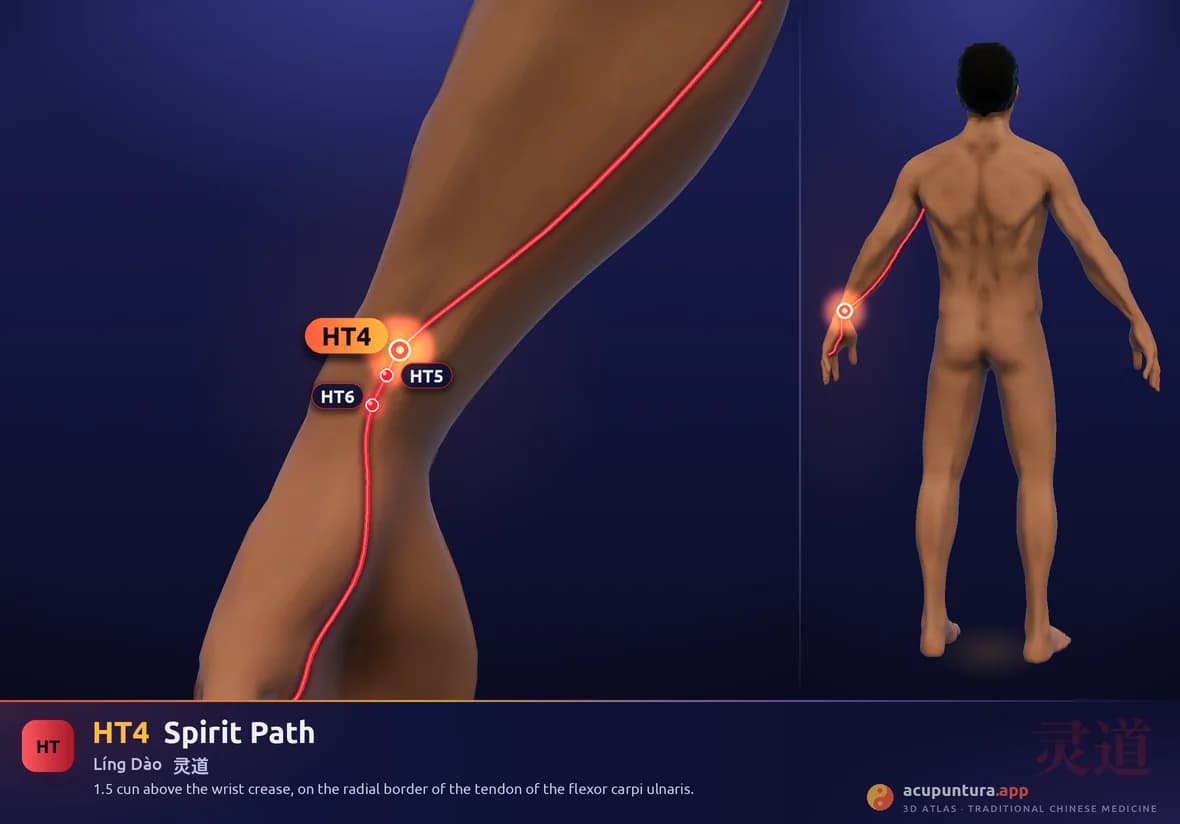
Heart Channel
Spirit Path
灵道Líng DàoAnatomical location
1.5 cun above the wrist crease, on the radial border of the tendon of the flexor carpi ulnaris.
Main function
Calms the Shen, clears Heat, benefits the arm.
- Jing-River point (Metal)
Therapeutic indications
- Palpitations
- chest pain
- insomnia
- wrist pain
- sudden loss of voice
- elbow contracture
- sadness
- fear
- heart pain
- forearm spasm
Name and classical tradition
Lingdao, 灵道, is the “path of the spirit.” 灵 (靈) is the spirit, the numinous, and here it refers to the Shen that, according to Chinese medicine, resides in the Heart; 道 is the path, the way. The point would be the route by which the channel’s Qi travels toward the dwelling of the spirit. This is the usual gloss in textbooks, reasonable but without a citation from an ancient commentator.
The Zhenjiu Jiayi Jing (Systematic Classic of Acupuncture and Moxibustion) gives it an entry in the work’s characteristic format: “灵道者,金也。在掌后一寸五分,或曰一寸,手少阴脉之所行也,为经.” Lingdao is Metal; it lies one and a half cun behind the palm, or one cun according to others; the hand Shaoyin passes through it; it is the Jing-River point (經穴). The quotation comes from a secondary source and should be checked against the text, but its content is consistent with the doctrine. The hesitation over the measurement, “一寸五分,或曰一寸,” is interesting, because it shows that two locations already coexisted in the third century.