Heart Channel
Lesser Sea
少海Shào HǎiAnatomical location
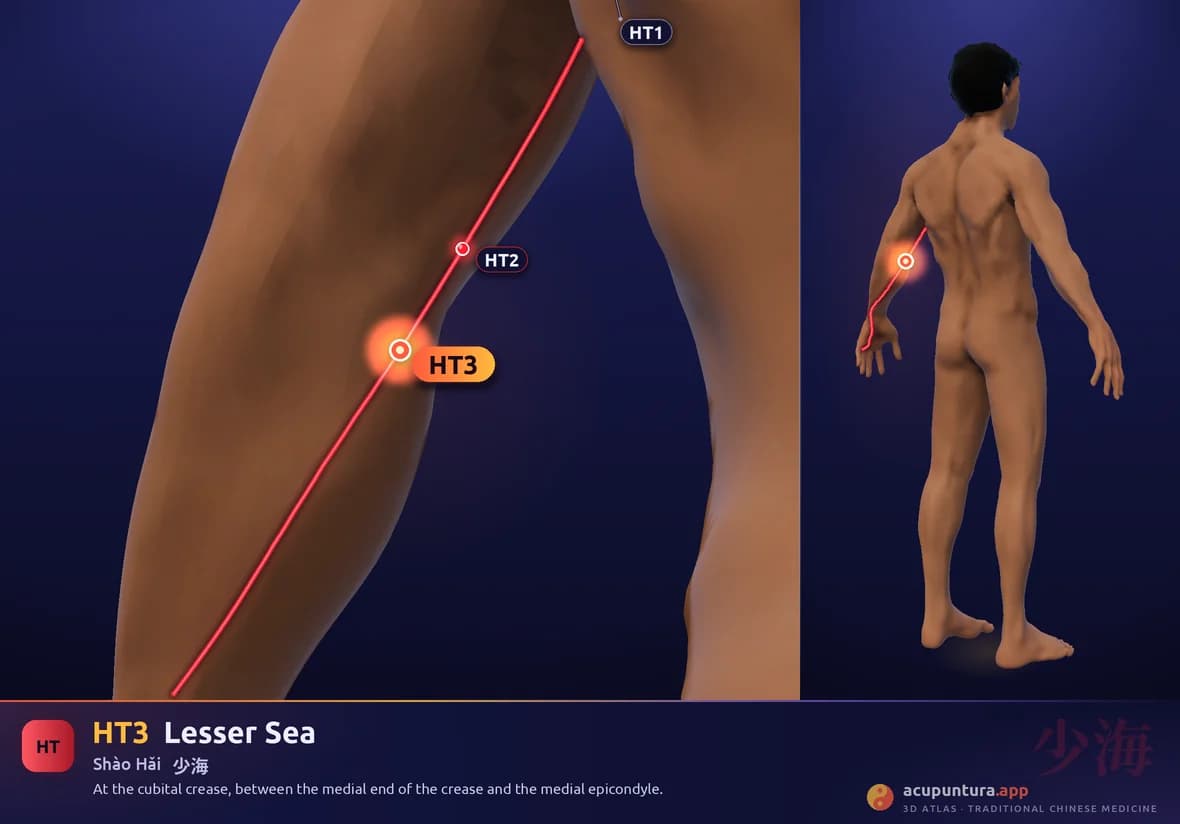
At the cubital crease, between the medial end of the crease and the medial epicondyle.
Main function
Calms the Shen, clears Heat, benefits the elbow.
- He-Sea point (Water)
Therapeutic indications
- Elbow pain
- palpitations
- insomnia
- headache
- numbness of the arm
- hand tremor
- dizziness
- scrofula
- mental disorders
- amnesia
- axillary pain
- restricted elbow movement
Name and classical tradition
Shaohai, 少海, is the “sea of the Shaoyin.” 少 refers to the channel, the hand Shaoyin, or is read as “little,” a still-young water; 海 is the sea. It is the He-Sea point (合穴) of the channel, the place where, according to the theory of the five transport points, the Qi that has traveled the arm from the fingertip flows out like rivers into the sea. This is the standard reading, consistent with the doctrine, although no ancient commentator signs it.
Like the other transport points of the Heart, Shaohai does not appear in the Ben Shu of the Lingshu (Spiritual Pivot), which assigns that function to the Pericardium channel, and its first mention as a point of the channel is in the Zhenjiu Jiayi Jing (Systematic Classic of Acupuncture and Moxibustion).
Its alternative name, 曲节, is a good example of a descriptive name: 曲, what bends, and 节, the joint, the knot of a branch. It alludes to the crease of the elbow where the point is located. It has not been possible to establish in which ancient text it first appears. Shaohai, written with 少, should be distinguished from the He-Sea point of the Small Intestine, SI8, Xiaohai, written with 小. Both are at the elbow and their names sound similar, but they are different points on different channels.
Other names
- 曲節Jiayi Jing