Heart Channel
Inner Communication
通里Tōng LǐAnatomical location
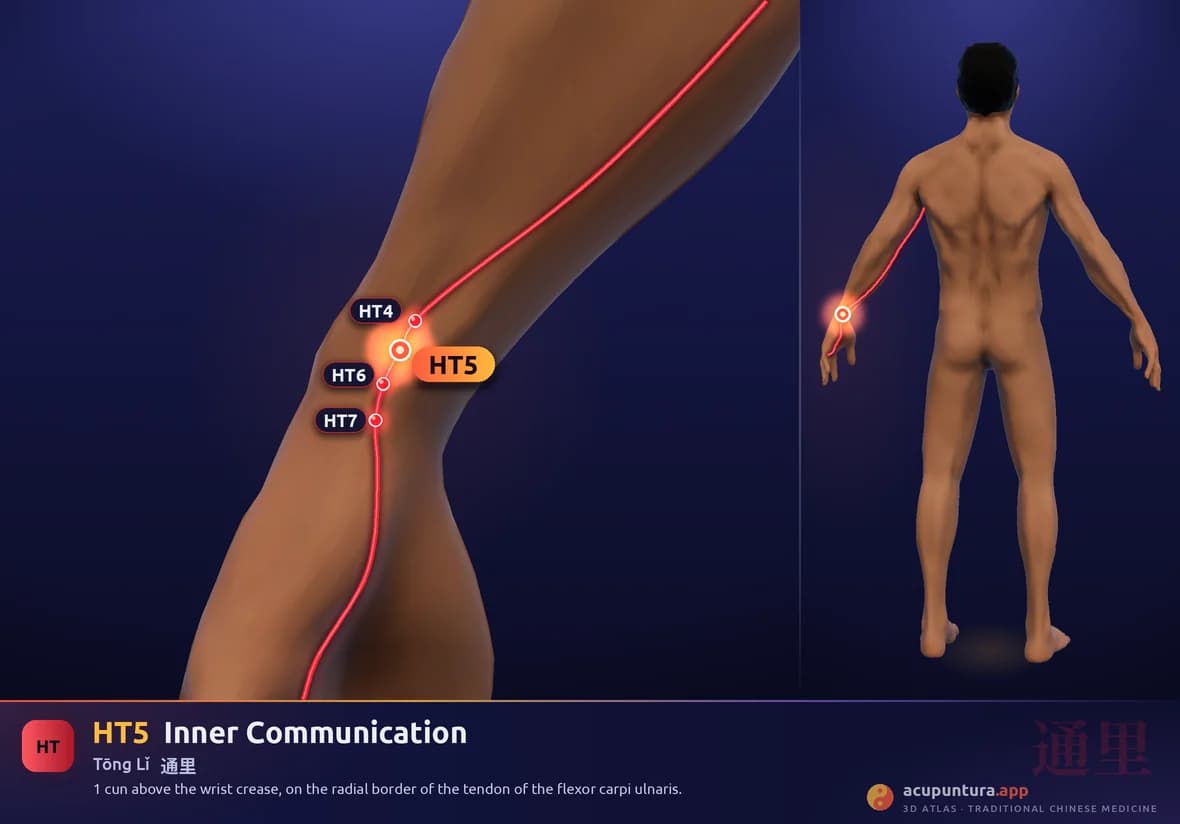
1 cun above the wrist crease, on the radial border of the tendon of the flexor carpi ulnaris.
Main function
Calms the Shen, benefits the tongue, regulates Heart Qi.
- Luo (Connecting) point
Therapeutic indications
- Aphasia
- palpitations
- insomnia
- sore throat
- aphasia after stroke
- bradycardia
- anxiety
- stiff tongue
- enuresis
- metrorrhagia
- wrist pain
- vertigo
- bipolar disorder (alternating Dian-Kuang)
- depression
Name and classical tradition
Tongli, 通里, is probably the only point of the Heart channel with a genuine mention in the Lingshu (Spiritual Pivot). Although the Ben Shu chapter omits the transport points of the Heart, the Jing Mai (經脈) chapter describes the collaterals of all the channels, and there appears that of the hand Shaoyin, whose point is Tongli. The passage attributes to it a striking symptom: “虛則不能言,” in deficiency, one cannot speak. Later clinical tradition has kept that relationship between the point and the tongue and speech, and has used it for stiffness of the tongue, sudden loss of voice, and palpitations.
The name has two readings. In the first, 通 is to communicate and 里 (裡), what is near, the neighborhood: as a Luo-Connecting point (絡穴), Tongli connects the Heart channel with its paired channel, the Small Intestine. In the second, more suggestive reading, 里 would be an abbreviation of 虛里, the term the Suwen (Basic Questions), in the Ping Ren Qi Xiang Lun (平人氣象論) chapter, uses for the beat of the apex of the heart. Tongli would then mean “the one that communicates with the heart.” This second reading is interpretive and has not been found in any ancient commentator.
Sun Simiao’s Beiji Qianjin Yaofang (Essential Prescriptions Worth a Thousand Gold for Emergencies) also records it under the name 通里.