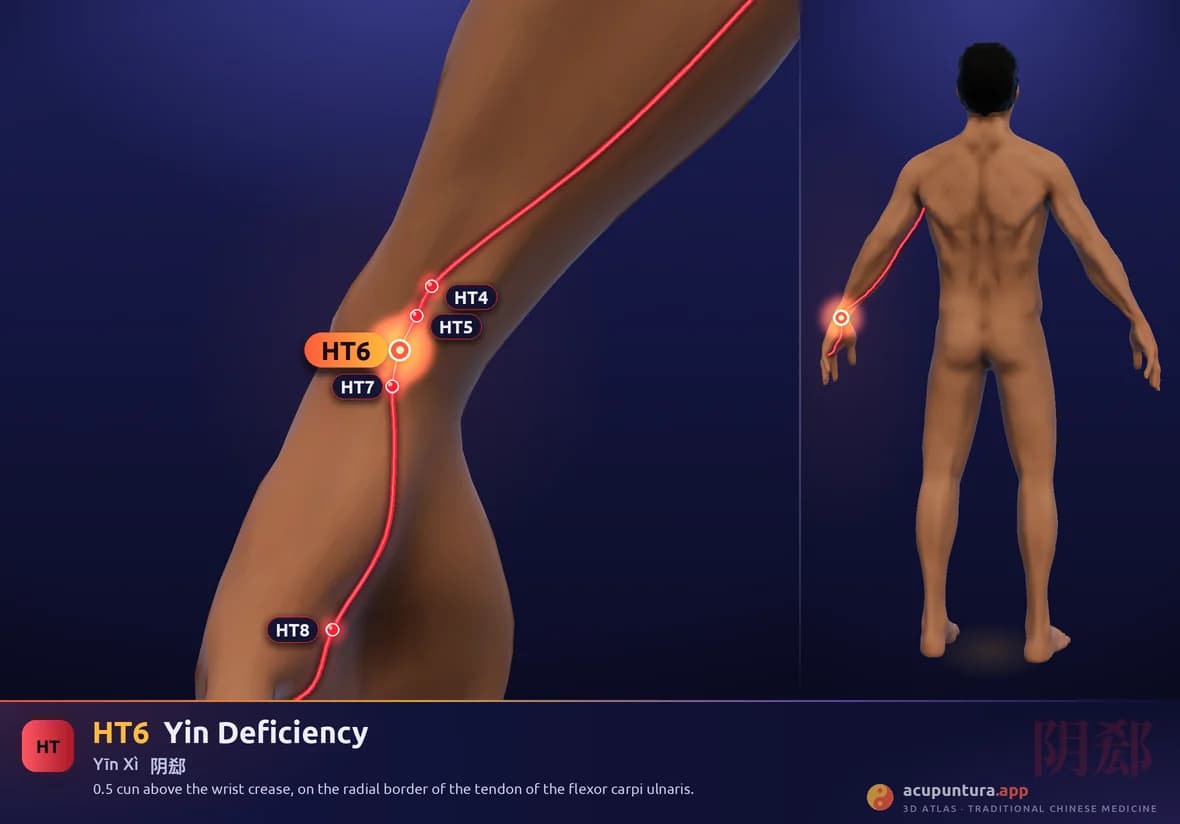
Heart Channel
Yin Deficiency
阴郄Yīn XìAnatomical location
0.5 cun above the wrist crease, on the radial border of the tendon of the flexor carpi ulnaris.
Main function
Nourishes Heart Yin, clears Heat, stops sweating.
- Xi-Cleft point
Therapeutic indications
- Night sweats
- palpitations
- hemoptysis
- insomnia
- hot flashes
- acute heart pain
- fear
- epistaxis
- anxiety
- loss of voice
Name and classical tradition
Yinxi, 阴郄, is the “cleft of the Yin.” 阴 (陰) refers to the channel, the Shaoyin; 郄, the cleft, is the technical term for the Xi-Cleft points (郄穴), those where the Qi and Blood of the channel accumulate in the depths, and which are used in acute conditions. The name is therefore not a metaphor but a technical label: it is the Xi-Cleft point of the Yin channel of the Heart. A modern gloss adds that the channel’s water flows back through this cleft toward the depths of the Heart, with no classical citation.
The most valuable thing about the point is how its name came to be fixed. The Zhenjiu Jiayi Jing (Systematic Classic of Acupuncture and Moxibustion), in the third century, gives it no proper name and designates it by its function, 手少陰郄, the Xi-Cleft point of the hand Shaoyin. The Beiji Qianjin Yaofang, in the seventh century, already calls it 陰郄. The Waitai Miyao (Arcane Essentials from the Imperial Library), in the eighth, uses the form 少陰郄. Across three works the point moves from a functional description to a proper name.
The reference lists record another alternative name, 石宮, “stone palace,” which a modern gloss links to the Kidney. The alias seems better documented than the explanation that accompanies it.