Heart Channel
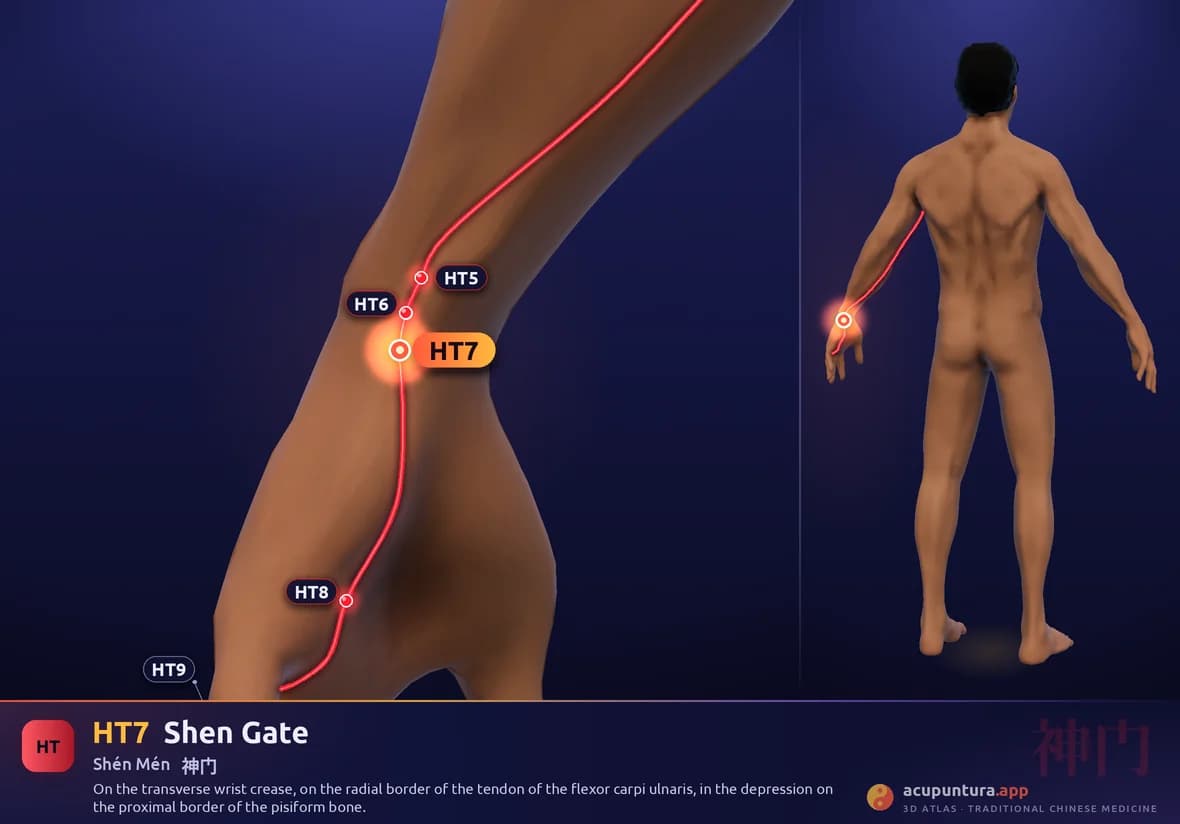
Shen Gate
神门Shén MénAnatomical location
On the transverse wrist crease, on the radial border of the tendon of the flexor carpi ulnaris, in the depression on the proximal border of the pisiform bone.
Main function
Calms the Shen, nourishes the Heart, regulates sleep.
- Yuan (Source) point
- Shu-Stream point (Earth)
- Sedation Point
- Ryodoraku Point H3 (Heart)
Therapeutic indications
- Insomnia
- palpitations
- anxiety
- amnesia
- excessive dreaming
- mania
- epilepsy
- dementia
- memory impairment
- chest pain
- heat in the palms
- wrist pain
- poor appetite
- hypertension
- schizophrenia (Dian Kuang)
- bipolar disorder (alternating Dian-Kuang)
- acute psychosis
- panic attacks (Ben Tun Qi)
- post-traumatic stress
- obsessive disorder (ruminating thoughts)
- depression
- cognitive decline and dementia
- addictions and smoking cessation
- bruxism
- hyperthyroidism
- premenstrual syndrome
Ryodoraku
H3CorazónMeasurement point no. 5
Yuan-Source point of the Heart, radial border of the pisiform.
- Sedation of Heart
Name and classical tradition
Shenmen, 神门, is the “gate of the spirit.” 神 is the Shen, the spirit that, according to the principle of the Suwen (Basic Questions), resides in the Heart (心藏神); 门 (門) is the gate. It is the Shu-Stream point (輸穴) of the channel and, at the same time, its Yuan-Source point (原穴), and the usual reading describes it as the gate through which Heart Qi enters and leaves. This is the gloss of the textbooks, consistent with classical physiology although no ancient commentator formulates it.
Like the rest of the points on the channel, it appears in the Zhenjiu Jiayi Jing (Systematic Classic of Acupuncture and Moxibustion). But the Nanjing (Classic of Difficulties), in Difficulty 66, devoted to the Yuan-Source points, gives it another name: “少陰之原,出於兌骨,” the Yuan-Source of the Shaoyin emerges at Duigu. 兌骨 designates the bone on the ulnar border of the wrist, next to which the point is located. If the reading is confirmed, it would be one of the oldest references to a point of the Heart channel outside the Jiayi Jing, in a work dated around the turn of the era.
Popular sources add other alternative names, such as 兌衝 and 銳中, with no classical citation to support them. Shenmen shares the 神 with other points on the body devoted to the spirit, such as GV24, Shenting, or GB13, Benshen.
Other names
- 兌沖Jiayi Jing
- 中都Jiayi Jing