Heart Channel
Lesser Surge
少冲Shào ChōngAnatomical location
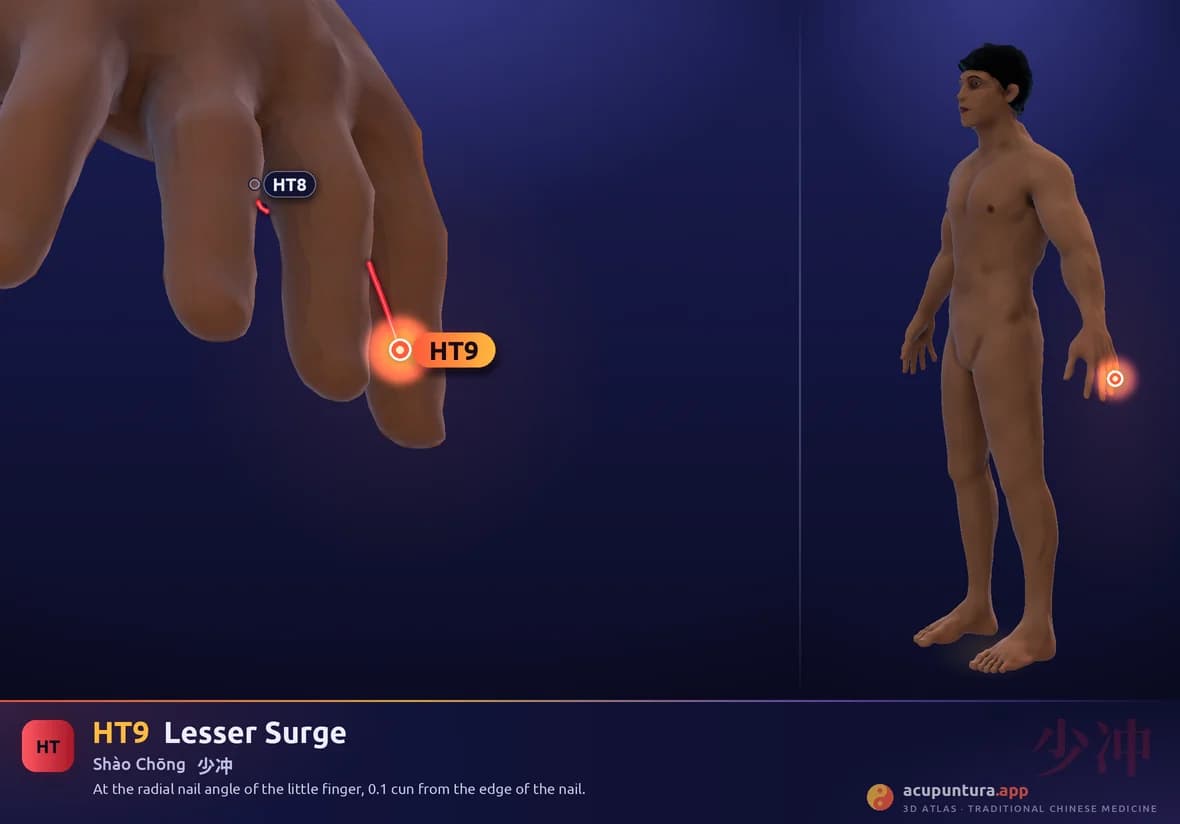
At the radial nail angle of the little finger, 0.1 cun from the edge of the nail.
Main function
Awakens the Shen, clears Heat, restores consciousness.
- Jing-Well point (Wood)
- Tonification Point
Therapeutic indications
- Loss of consciousness
- high fever
- palpitations
- chest pain
- Heart pain
- Anxiety
- Mania
- Pain in the little finger
- Heat in the palms
- Dry mouth
- Stroke
Ryodoraku
- Tonification of Heart
Name and classical tradition
Shaochong, 少冲, is the point where the Heart channel ends, at the tip of the little finger, beside the nail. 少 points to Shaoyin and also means “small” or “young”; 冲 (衝) means to burst forth, a crucial point of passage. As a Jing-Well point (井穴), it is where the Qi of the channel emerges to the exterior, and the name captures that outburst. On the Yin channels, the Well corresponds to Wood. This is the reading found in the manuals, and it is consistent with the doctrine of the Well points.
The same naming structure recurs on other fingers. PC9, Zhongchong, is the Pericardium Well point on the middle finger, and TE1, Guanchong, is the Triple Energizer Well point on the ring finger. They share the same 冲, each on its own finger and its own channel.
The Zhenjiu Jiayi Jing (Systematic Classic of Acupuncture and Moxibustion) gives it the alternative name 經始, “the beginning of the channel,” which expresses the idea that the Qi of each channel is born at its Well point. The ancient work that records this name has not been located. The earliest source for the point is the Zhenjiu Jiayi Jing, since the Lingshu (Spiritual Pivot) omits the transport points of the Heart.
Other names
- 經始Jiayi Jing