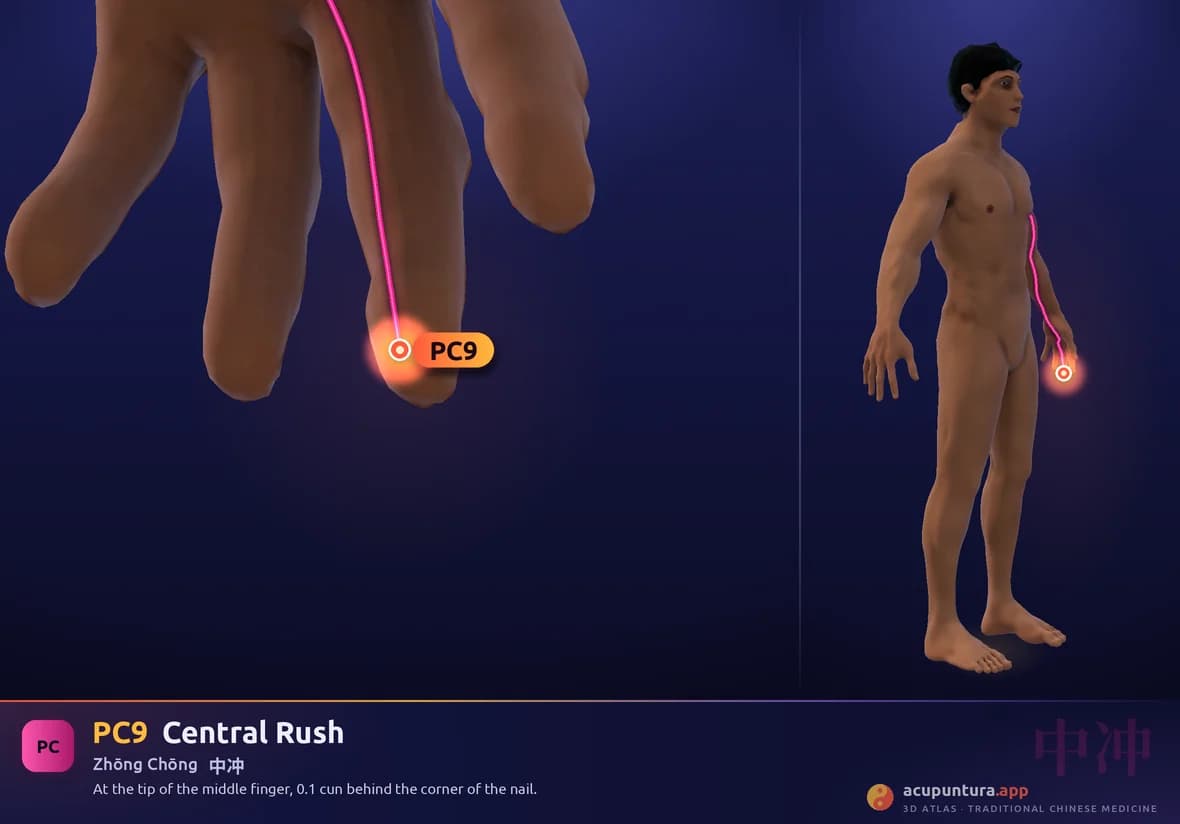
Pericardium Channel
Central Rush
中冲Zhōng ChōngAnatomical location
At the tip of the middle finger, 0.1 cun behind the corner of the nail.
Main function
Clears Heat, restores consciousness, calms Wind.
- Jing-Well point (Wood)
- Tonification Point
Therapeutic indications
- Loss of consciousness
- fever
- sore throat
- palpitations
- Heatstroke
- High fever
- Stroke
- Infantile convulsions
- Heart pain
- Stiff tongue
- Heat in the palms
Ryodoraku
- Tonification of Pericardium
Name and classical tradition
Zhongchong, 中衝, is the point where the channel begins, at the tip of the middle finger. 中 is the center, and the middle finger is the central finger of the hand; 衝 means to burst forth, to rush, to gush out. The name describes Qi surging out at the end of the finger. The image fits the doctrine of the Jing-Well points (井穴), which the Lingshu (Spiritual Pivot), in the Jiu Zhen Shi Er Yuan chapter (九針十二原), sums up in three characters: «所出為井», the place where Qi emerges is the well.
The Ben Shu chapter (本輸) opens the series of the five transport points of the channel with it: «心出於中衝,中衝,手中指之端也,為井木». The text does not say that the Pericardium emerges, but the Heart (心): Qi emerges at Zhongchong, at the tip of the middle finger; it is the Jing-Well point, of Wood nature. The passage continues through PC8, PC7, PC5, and PC3, and ends by calling the whole set «手心主經», the channel of the Heart Master. The name Pericardium (心包) for this channel became established later.
It is therefore no surprise that the reference works attribute to it the alternative name 手心主, the same as the channel. It could be a use of the first point in the series to name the whole, although the quotation that expressly assigns it to the point has not been located. Like the other Jing-Well points, Zhongchong has been used for emergency bloodletting at the tip of the finger, in fainting and heatstroke.