Kidney Channel
Great Manifestation
大赫DàhèUse caution during pregnancy
Lower abdominal chain of the Kidney over the uterus; avoid.
Anatomical location
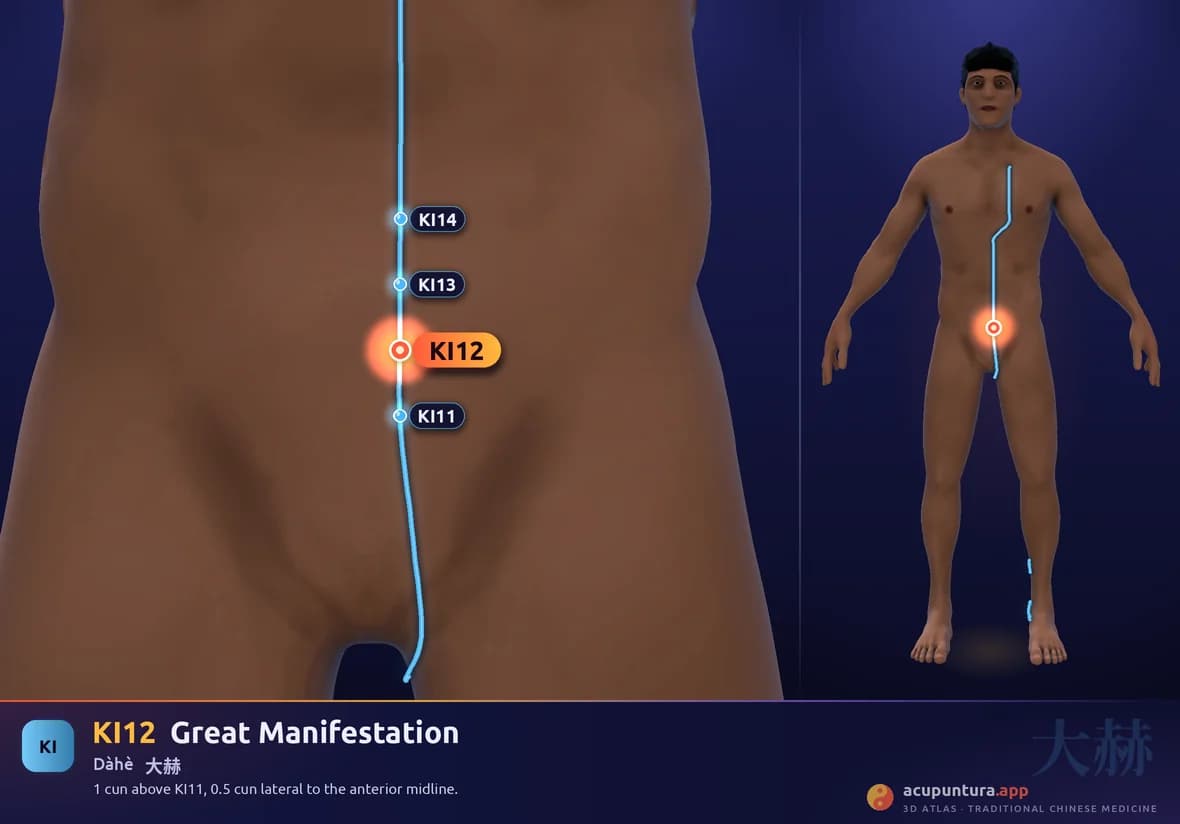
1 cun above KI11, 0.5 cun lateral to the anterior midline.
Main function
Strengthens the Kidney, regulates Kidney Qi, benefits the Lower Jiao, treats urogenital disorders.
- Crossing point with the Chong Mai
Therapeutic indications
- Dysmenorrhea
- leukorrhea
- enuresis
- impotence
- pelvic pain
- edema
- nocturnal emission
- irregular menstruation
- genital pain
- hypogastric pain
Name and classical tradition
Dahe, 大赫, means “great manifestation,” or “great radiance.” 大 is great, abundant; 赫 is resplendent, red as fire, the same character as in 赫赫, “dazzling.” The explanation modern manuals offer is that the Qi of the Chong Mai (Penetrating Vessel), warm and intense, emerges here toward the Kidney channel shining like fire. It is a modern physiological gloss, not an ancient philological interpretation.
The sources attribute it to the Zhenjiu Jiayi Jing (Systematic Classic of Acupuncture and Moxibustion), with no literal quotation located. It is a crossing point of the Chong Mai and the Kidney channel. The reference works give it the alternative names 陰關, “barrier of Yin,” and 陰維, which matches the name of the Yin Wei Mai, with no relation to it.
Other names
- 陰維Jiayi Jing
- 陰關Jiayi Jing