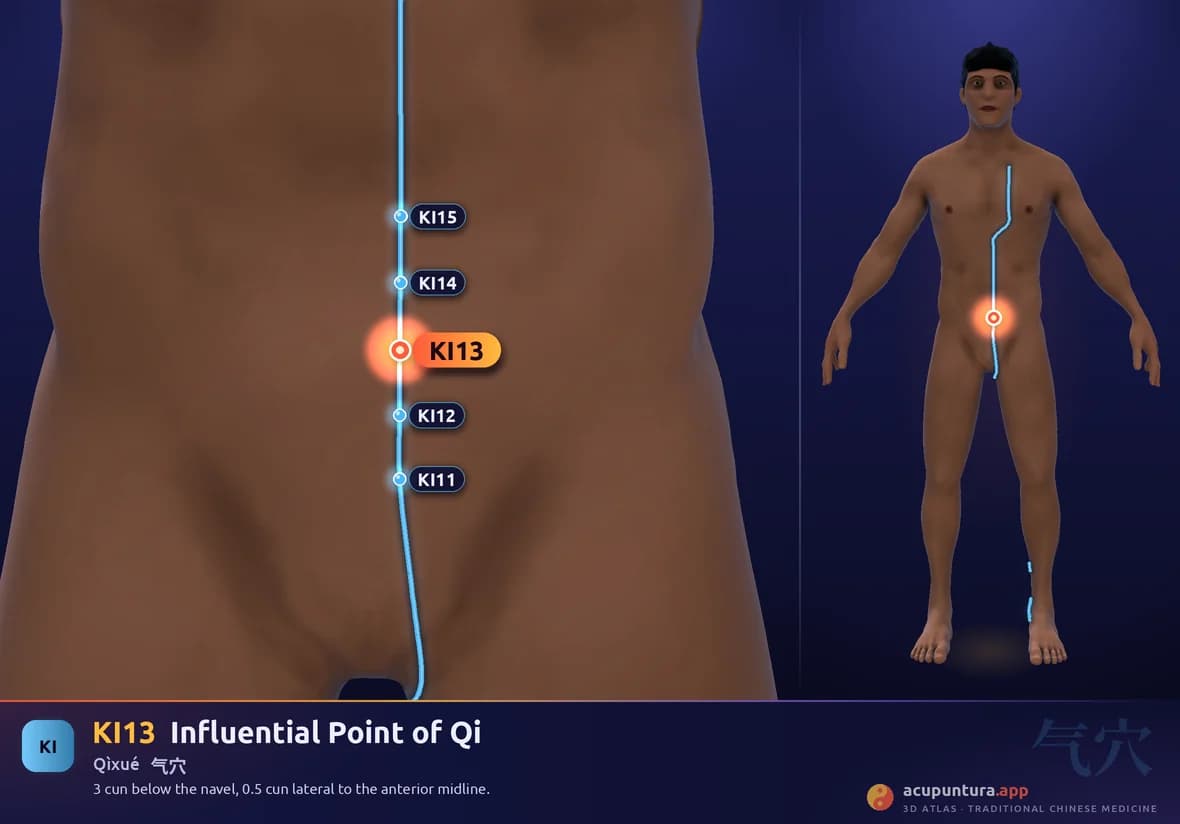
Kidney Channel
Influential Point of Qi
气穴QìxuéUse caution during pregnancy
Lower abdominal chain of the Kidney over the uterus; avoid.
Anatomical location
3 cun below the navel, 0.5 cun lateral to the anterior midline.
Main function
Regulates Kidney Qi, tonifies Kidney Yang, benefits the uterus and urination, calms the Shen.
- Crossing point with the Chong Mai
Therapeutic indications
- Infertility
- dysmenorrhea
- leukorrhea
- enuresis
- low back pain
- edema
- tinnitus
- irregular menstruation
- diarrhea
- hypogastric pain
- dysuria
Name and classical tradition
Qixue, 气穴, is the “Qi cavity.” 气 (氣) is Qi, the vital breath; 穴 is the cavity, the point. The explanation of the name points to its proximity to CV4, Guanyuan, the place where Original Qi is concentrated. In the tradition of internal cultivation the formula “凝神入氣穴” appears, concentrating the spirit in the cavity of Qi, although the exact text it comes from has not been located.
Its alternative names, already recorded in the Zhenjiu Jiayi Jing (Systematic Classic of Acupuncture and Moxibustion), are eloquent: 胞門, “gate of the uterus,” and 子戶, “house of the child.” The same work places it “在四滿下一寸”, one cun below KI14, and attributes to it “婦人子宮久冷,不能成孕,赤白淋瀝,月事不調”: a uterus long cold that prevents pregnancy, red or white discharge, irregular menstruation. The aliases and the indications tell the same story.
It is a crossing point of the Chong Mai (Penetrating Vessel) and the Kidney channel, and the tradition has also used it for Ben Tun (奔豚氣), the Qi that rises like a runaway piglet.
Other names
- 胞門Jiayi Jing
- 子戶Jiayi Jing