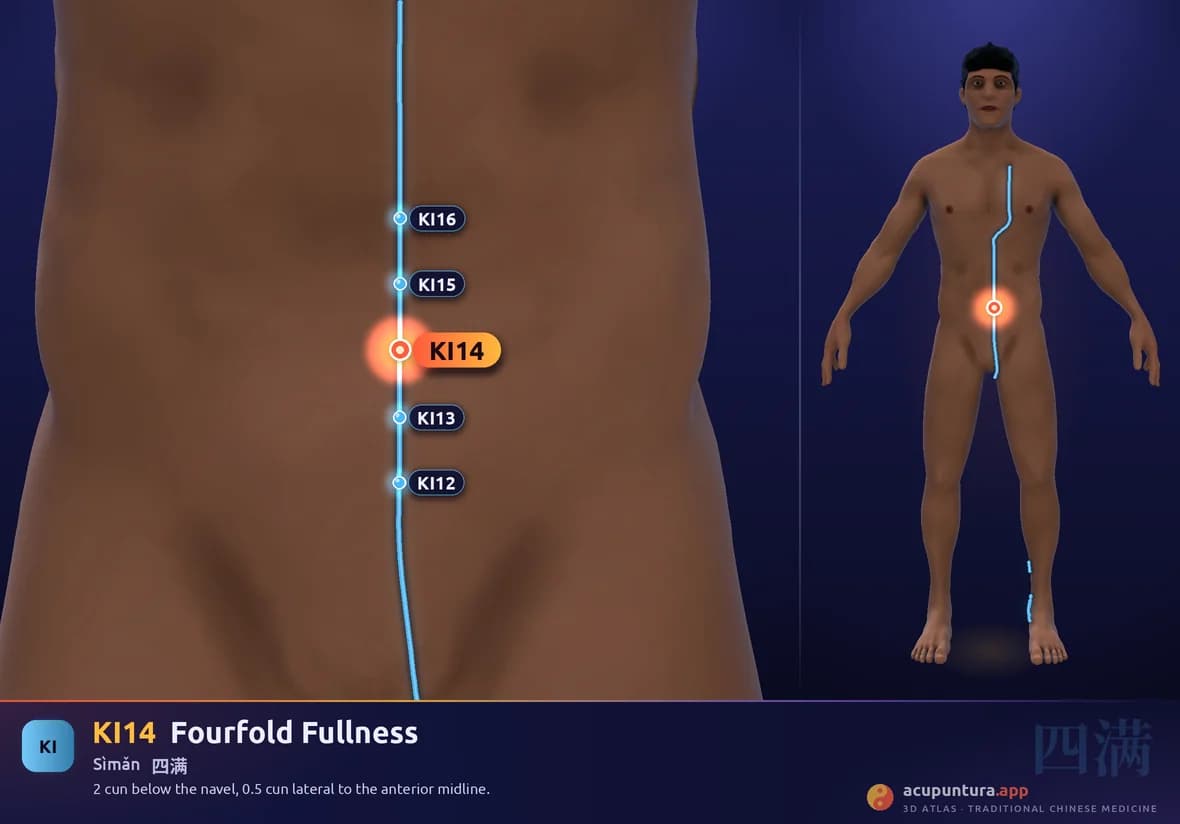
Kidney Channel
Fourfold Fullness
四满SìmǎnUse caution during pregnancy
Lower abdominal chain of the Kidney over the uterus; avoid.
Anatomical location
2 cun below the navel, 0.5 cun lateral to the anterior midline.
Main function
Regulates Kidney Qi, strengthens the Spleen and Stomach, harmonizes the Middle Jiao, and treats digestive disorders.
- Crossing point with the Chong Mai
Therapeutic indications
- Abdominal pain
- diarrhea
- dyspepsia
- nausea
- enuresis
- low back pain
- menstrual irregularity
- infertility
- persistent lochia
- abdominal masses
- edema
Name and classical tradition
Siman, 四满, means "four fullnesses" or "fullness on all four sides." 四 is four, and also all directions; 满 (滿) is full, brimming. Modern sources give two explanations: it would be the fourth point of the channel on the abdomen, where the Qi is already full, or else the point that treats abdominal distension in every direction. Neither has a classical citation.
The sources attribute it to the Zhenjiu Jiayi Jing (Systematic Classic of Acupuncture and Moxibustion), with no verbatim quotation. It is a crossing point of the Chong Mai and the Kidney channel. The reference works give it the alternate names 髓府, "palace of the marrow," and 髓中. A third, 髓海, "sea of marrow," is also the classical term the Lingshu (Spiritual Pivot) uses for the brain, and may be a generic term attributed to this point by mistake.
Other names
- 髓府Jiayi Jing