Kidney Channel
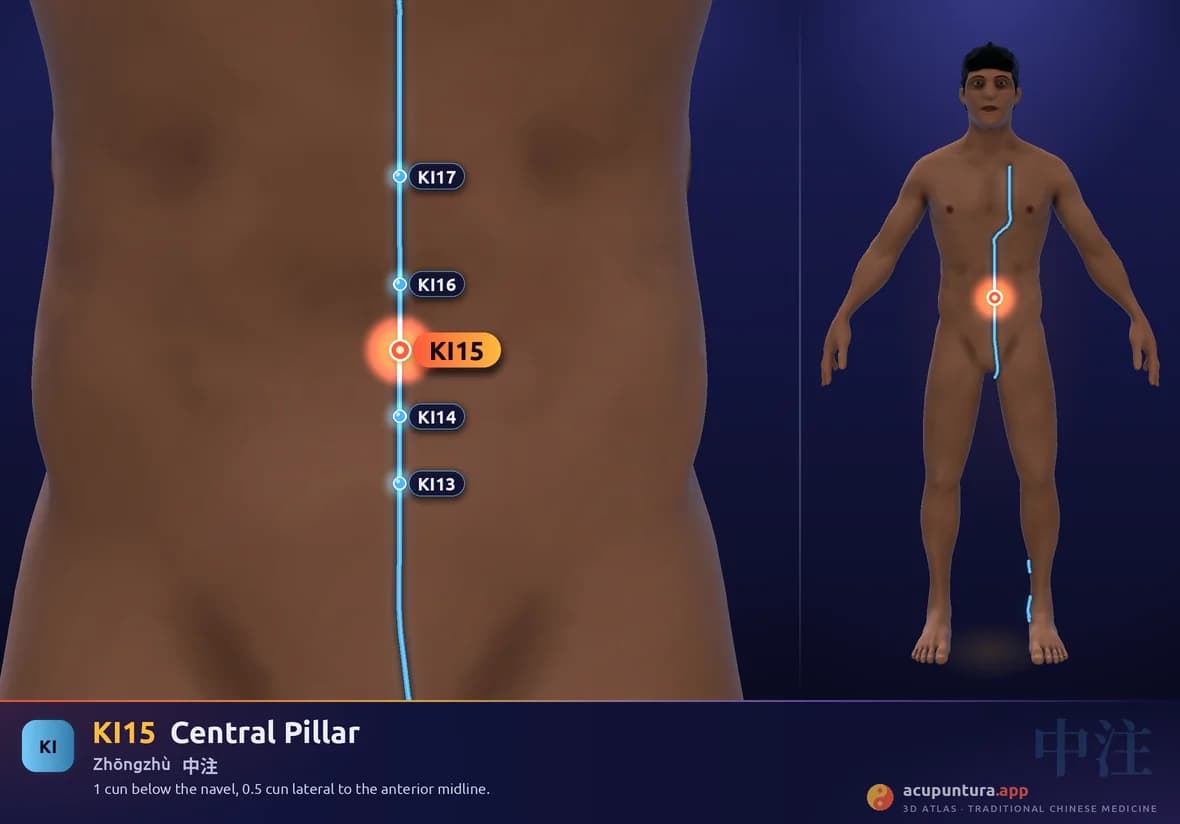
Central Pillar
中注ZhōngzhùUse caution during pregnancy
Lower abdominal chain of the Kidney over the uterus; avoid.
Anatomical location
1 cun below the navel, 0.5 cun lateral to the anterior midline.
Main function
Regulates Kidney Qi, strengthens the lumbar region, and benefits the Lower Jiao and the genitals.
- Crossing point with the Chong Mai
Therapeutic indications
- Dysmenorrhea
- leukorrhea
- enuresis
- low back pain
- edema
- diarrhea
- menstrual irregularity
- abdominal pain
- constipation
Name and classical tradition
Zhongzhu, 中注, combines 中, the middle or interior, and 注, to pour or infuse. The modern gloss understands it as the place where the descending water of the Kidney channel and the Chong Mai is poured inward. This is a textbook explanation with no ancient philological support.
It is one of the channel's least documented points. The sources attribute it to the Zhenjiu Jiayi Jing (Systematic Classic of Acupuncture and Moxibustion), with no verbatim quotation, and no alternate names are known. What is certain is that it is a crossing point of the Chong Mai and the Kidney channel, on the stretch that begins at KI11 and rises to KI21.