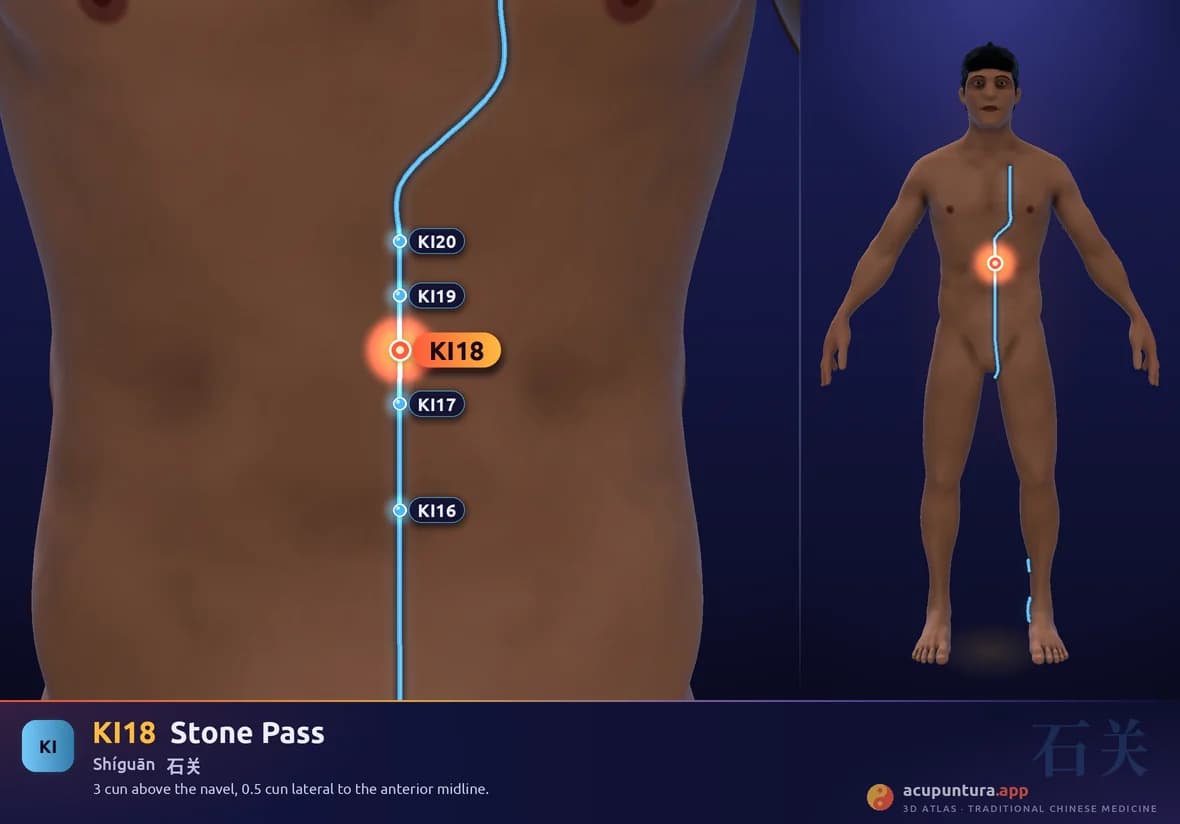
Kidney Channel
Stone Pass
石关ShíguānAnatomical location
3 cun above the navel, 0.5 cun lateral to the anterior midline.
Main function
Regulates Kidney Qi, strengthens the Spleen and Stomach, harmonizes the Middle Jiao, and treats digestive disorders.
- Crossing point with the Chong Mai
Therapeutic indications
- Abdominal pain
- diarrhea
- dyspepsia
- nausea
- epigastric fullness
- constipation
- postpartum vomiting
- infertility
- hiccups
Name and classical tradition
Shiguan, 石关, is the "stone barrier." 石, stone, also designates in classical physiology a dense, stagnant water, as in 石水, "stone water," a type of abdominal edema; 关 (關) is the barrier, the control point. The sources give two explanations: the point would be key for treating that edema, or else it would mark the level of the pylorus, where food passes into the intestine. These are two separate glosses, not fully reconciled.
There is one historical fact with a specific source: the Taiping Shenghui Fang, from the Song period, records the point under the name 右關, "right barrier." The reference works add 石闕, "stone pillar." Other aliases in circulation, such as 石門, are actually names of different points, in this case CV5, and are not included here. The sources trace the point to the Zhenjiu Jiayi Jing (Systematic Classic of Acupuncture and Moxibustion) and regard it as a crossing point of the Chong Mai and the Kidney channel. It lies at the level of ST22, Guanmen, on the Stomach channel.