Kidney Channel
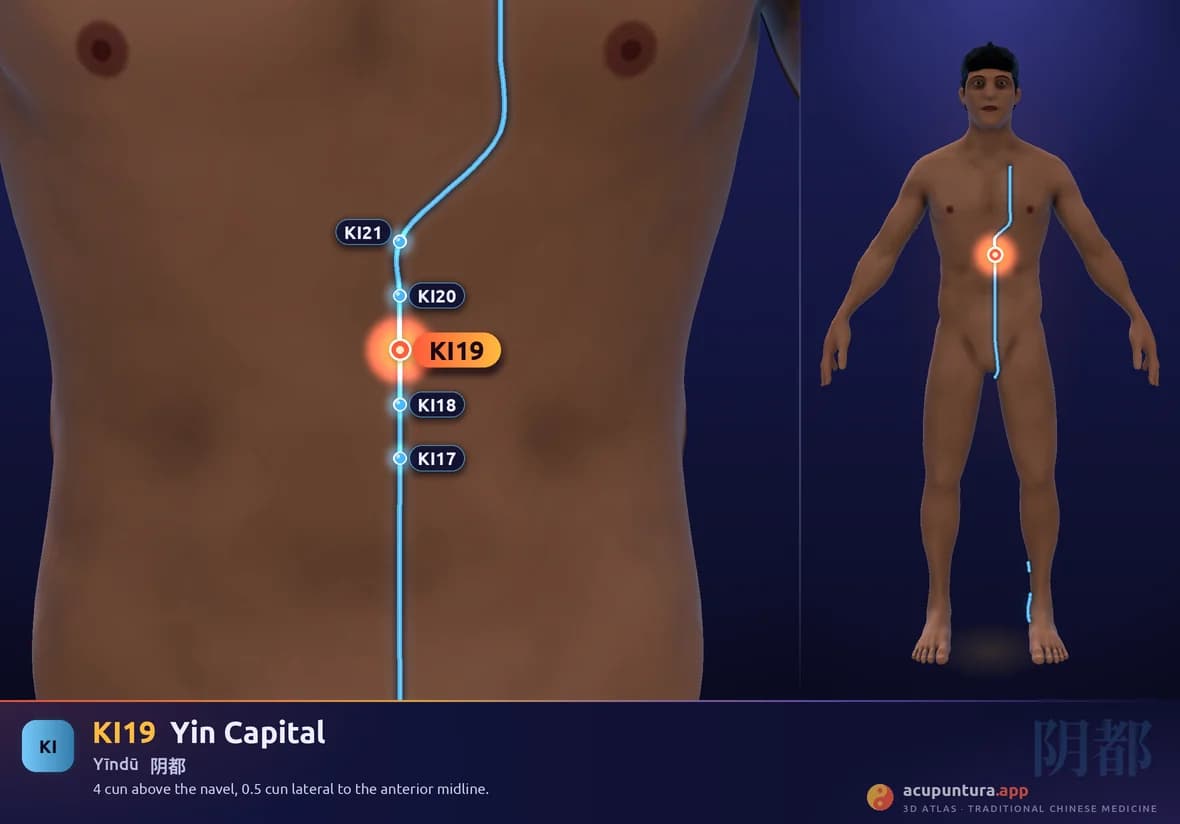
Yin Capital
阴都YīndūAnatomical location
4 cun above the navel, 0.5 cun lateral to the anterior midline.
Main function
Regulates Kidney Qi, strengthens the Spleen and Stomach, harmonizes the Middle Jiao, and treats digestive disorders.
- Crossing point with the Chong Mai
Therapeutic indications
- Abdominal pain
- diarrhea
- dyspepsia
- nausea
- epigastric fullness
- abdominal distension
- borborygmi
- infertility
- vomiting
- asthma
Name and classical tradition
Yindu, 阴都, is the "capital of Yin." 阴 (陰) is Yin, the cold and damp; 都 is the capital, the city, and more broadly the place where something gathers, the marketplace. The modern gloss understands that the damp Qi rising along the Kidney channel and the Chong Mai converges and disperses here. It is the same 都 as in SP2, Dadu.
Its alternate names share a digestive theme that fits the point's indications, abdominal distension and digestive disorders: 食宮, "palace of food," 食呂, and 通關. Other variants, such as 石宮, appear to be transcription errors for 食宮 and are not included. The sources trace the point to the Zhenjiu Jiayi Jing (Systematic Classic of Acupuncture and Moxibustion), with no verbatim quotation, and regard it as a crossing point of the Chong Mai and the Kidney channel.
Other names
- 食宮Jiayi Jing