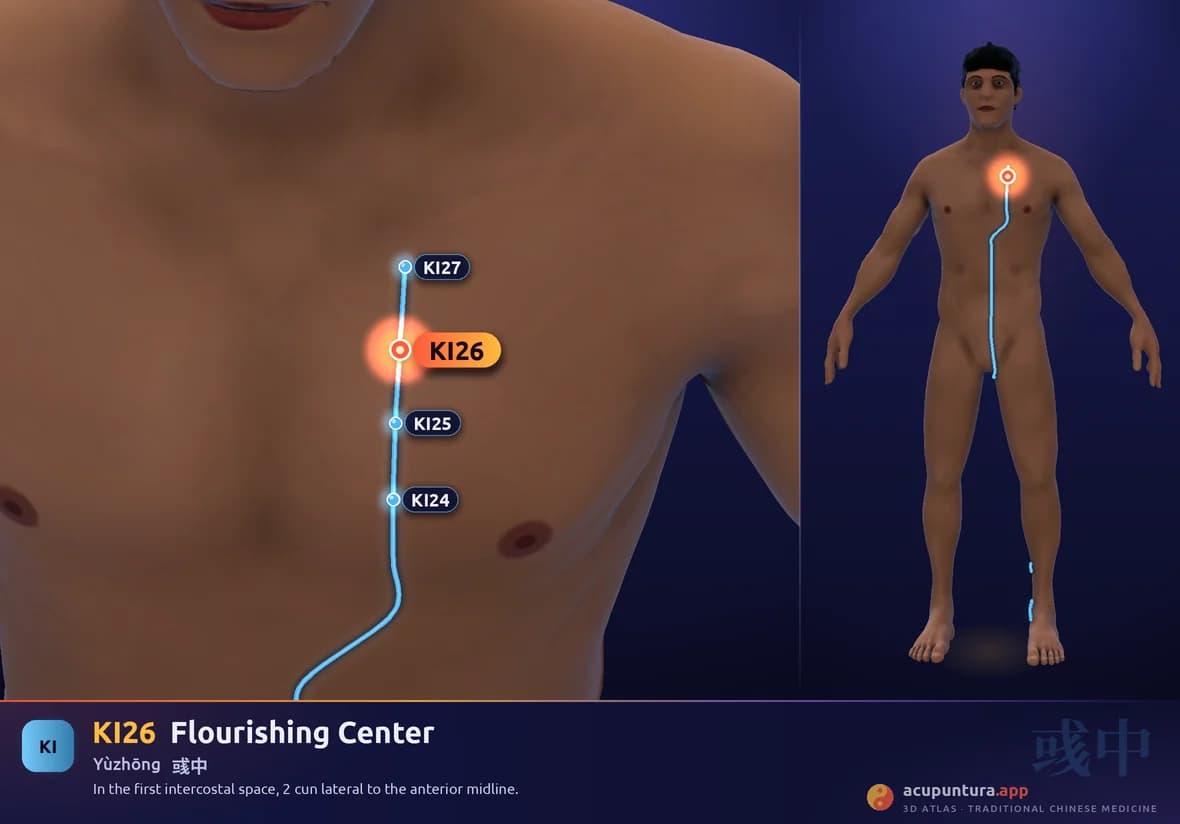
Kidney Channel
Flourishing Center
彧中YùzhōngAnatomical location
In the first intercostal space, 2 cun lateral to the anterior midline.
Main function
Regulates Lung Qi, benefits the chest, and treats respiratory and thoracic disorders.
- Crossing point with the Lung
Therapeutic indications
- Cough
- asthma
- chest pain
- anxiety
- nausea
- chest fullness
- poor appetite
Name and classical tradition
Yuzhong, 彧中, carries an uncommon character: 彧 means refined, flourishing, and is applied to the elegance of letters and culture. The translation as "center of jade" rests on the homophony with 玉, jade, rather than on the character itself. The reading the sources give links the name to the Lung, which a certain tradition regards as the seat of refined expression; the point is on the chest, near that organ. The connection has not been verified in an ancient text.
What is documented is the instability of its writing. The Zhenjiu Jiayi Jing (Systematic Classic of Acupuncture and Moxibustion) records it as 彧中; Sun Simiao's Qianjin Yaofang writes it 或中, and the Yixue Rumen, in the Ming period, 域中. These are graphic variants of a single name, not different names, and they show how a rare character tends to be replaced by more common ones with a similar sound. The point lies in the first intercostal space, just below KI27.