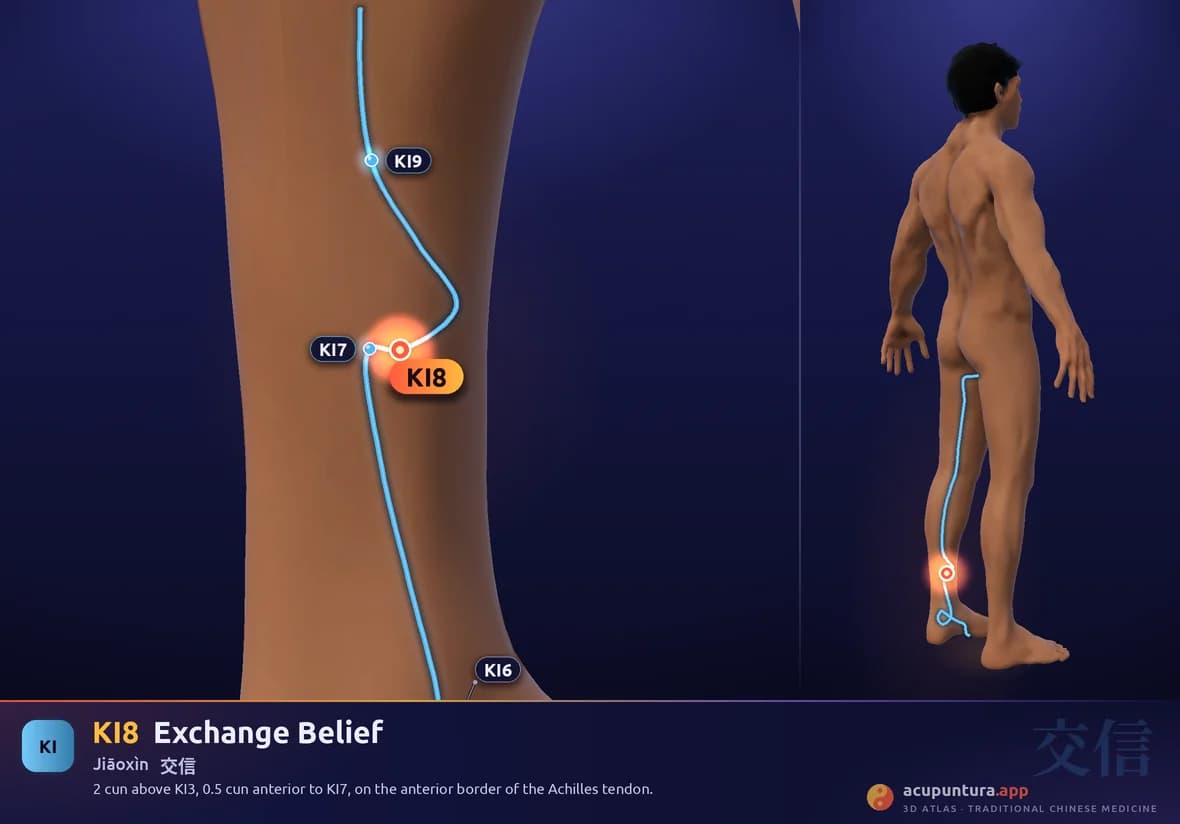
Kidney Channel
Exchange Belief
交信JiāoxìnAnatomical location
2 cun above KI3, 0.5 cun anterior to KI7, on the anterior border of the Achilles tendon.
Main function
Regulates the Yin Qiao Mai, strengthens the Kidney, consolidates the Essence (Jing), regulates urination and menstruation, calms the Shen.
- Xi-Cleft Point of the Yin Qiao Mai
- Crossing point with the Yin Qiao Mai
- Crossing point with the Spleen
Therapeutic indications
- Dysmenorrhea
- metrorrhagia
- leukorrhea
- enuresis
- low back pain
- anxiety
- insomnia
- irregular menstruation
- uterine prolapse
- diarrhea
- constipation
- testicular pain
Name and classical tradition
Jiaoxin, 交信, combines 交, to cross or exchange, and 信, which means trust but also signal, regularity, punctuality. The reference works stress this last sense: the point has been used to regulate menstruation, which arrives in its own time. The other half of the name points to an exchange: according to the sources, the Qi of the channel crosses here with that of SP6, Sanyinjiao, the crossing of the three Yin. These are modern glosses, consistent with how the point is used.
Jiaoxin is the Xi-Cleft point (郄穴) of the Yin Qiao Mai, the accumulation point of that Extraordinary Vessel, which opens at KI6. The first work to record it is the Zhenjiu Jiayi Jing (Systematic Classic of Acupuncture and Moxibustion). The reference works give it the alternative name 內筋, “inner sinew.”