Kidney Channel
Shining Sea
照海ZhàohǎiAnatomical location
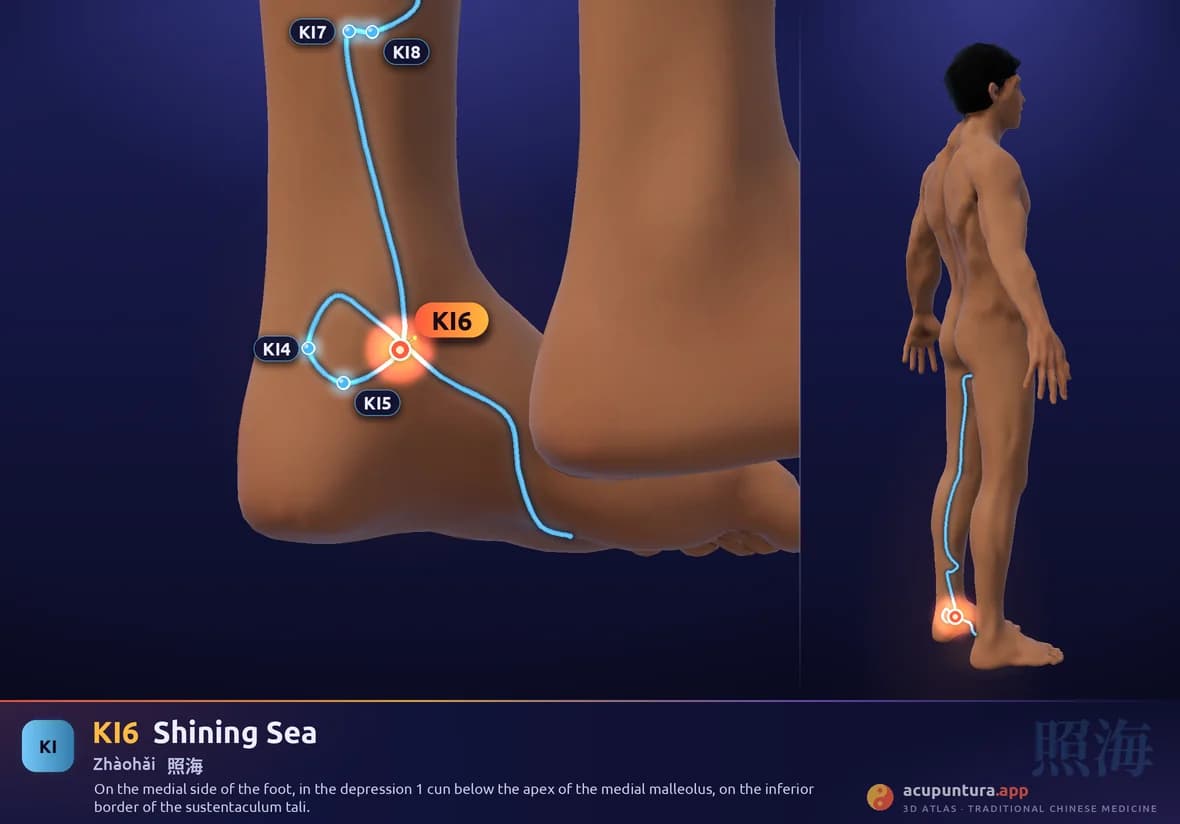
On the medial side of the foot, in the depression 1 cun below the apex of the medial malleolus, on the inferior border of the sustentaculum tali.
Main function
Regulates the Yin Qiao Mai, benefits the throat, harmonizes Kidney Yin and Yang, regulates urination, calms the Shen, and treats sleep disorders.
- Opening point of the Yin Qiao Mai
Therapeutic indications
- Insomnia
- anxiety
- sore throat
- dysmenorrhea
- leukorrhea
- enuresis
- low back pain
- leg weakness
- dry throat
- chronic sore throat
- daytime sleepiness
- nocturnal epilepsy
- irregular menstruation
- uterine prolapse
- genital itching
- constipation due to dryness
- dysuria
- ankle pain
- bipolar disorder (Dian-Kuang alternation)
- post-traumatic stress
- fibromyalgia
- diabetes mellitus (Xiao Ke)
- COPD and chronic bronchitis
Name and classical tradition
Zhaohai, 照海, is the “shining sea.” 照 means to illuminate, to light up; 海 is the sea. The image is that of a sea of Yin Qi lit up, and it is tied to the point's role as the opening point of the Yin Qiao Mai, one of the Extraordinary Vessels. It is a modern reading, with no classical citation.
Zhaohai is one of the eight confluent points (八脈交會穴), the one that opens the Yin Qiao Mai. Its counterpart on the Yang side is BL62, Shenmai, which opens the Yang Qiao Mai at the opposite ankle. The reference works give it the alternative name 陰蹻, which matches the name of the vessel: it may be a genuine alias or a confusion between the name of the vessel and that of the point, and should be taken with caution. Its name first appears in the Zhenjiu Jiayi Jing (Systematic Classic of Acupuncture and Moxibustion).