Kidney Channel
Guest House
筑宾ZhùbīnAnatomical location
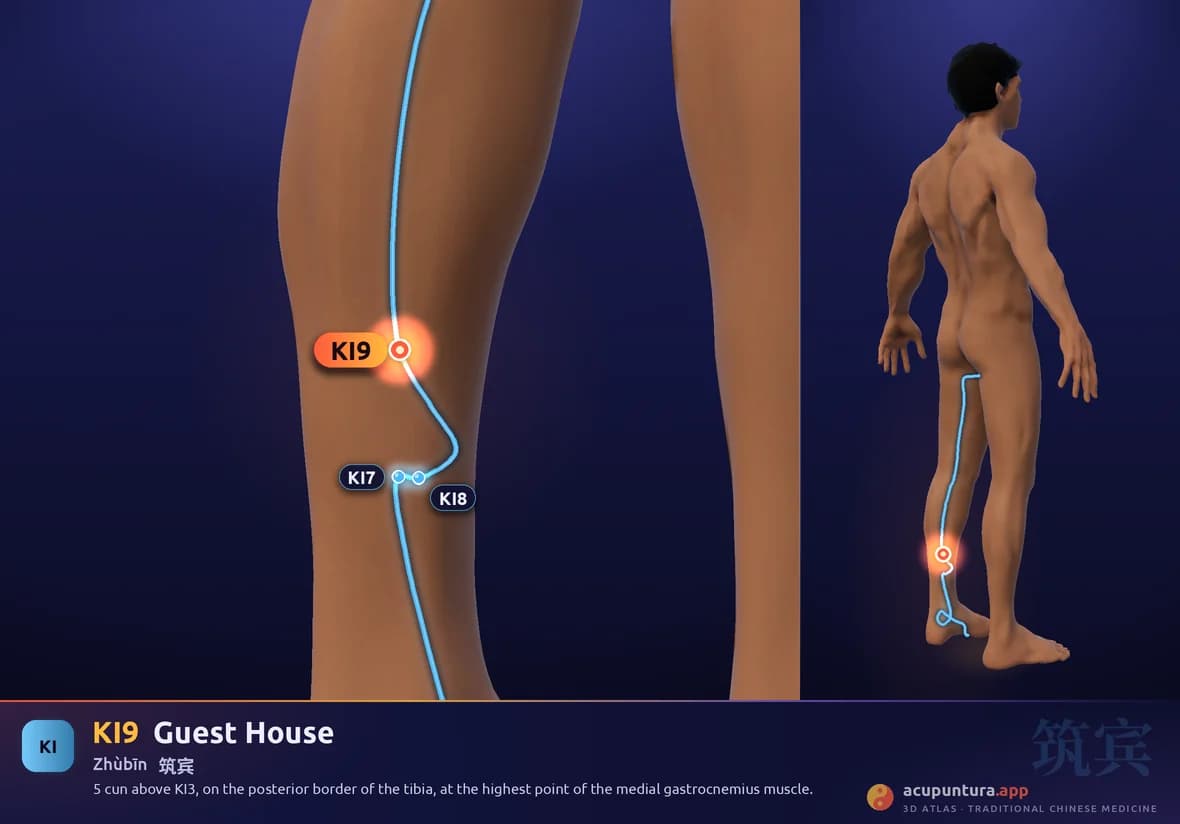
5 cun above KI3, on the posterior border of the tibia, at the highest point of the medial gastrocnemius muscle.
Main function
Regulates the Yin Wei Mai, calms the Shen, resolves Phlegm, eliminates Internal Wind, and treats mental disorders.
- Xi-Cleft point of the Yin Wei Mai
Therapeutic indications
- Epilepsy
- insomnia
- anxiety
- low back pain
- leg weakness
- mental disorders
- mania
- calf pain and cramping
- hernia
- poisoning
- foot pain
- panic attacks (Ben Tun Qi)
Name and classical tradition
Zhubin, 筑宾, combines 筑 (築), which means to build or construct and is also the name of an ancient stringed percussion instrument, and 宾 (賓), the guest or visitor. Neither character alludes to a valley, despite the translation it is sometimes given. A modern gloss, with no classical backing, understands that the Qi of the three foot Yin channels, after mingling lower down, arrives here and is received in the Kidney channel like a guest.
Zhubin is the Xi-Cleft point (郄穴) of the Yin Wei Mai, the accumulation point of that Extraordinary Vessel. The first work to record it is the Zhenjiu Jiayi Jing (Systematic Classic of Acupuncture and Moxibustion). Neither aliases nor ancient glosses accompany this point.