Kidney Channel
Yin Valley
阴谷YīngǔAnatomical location
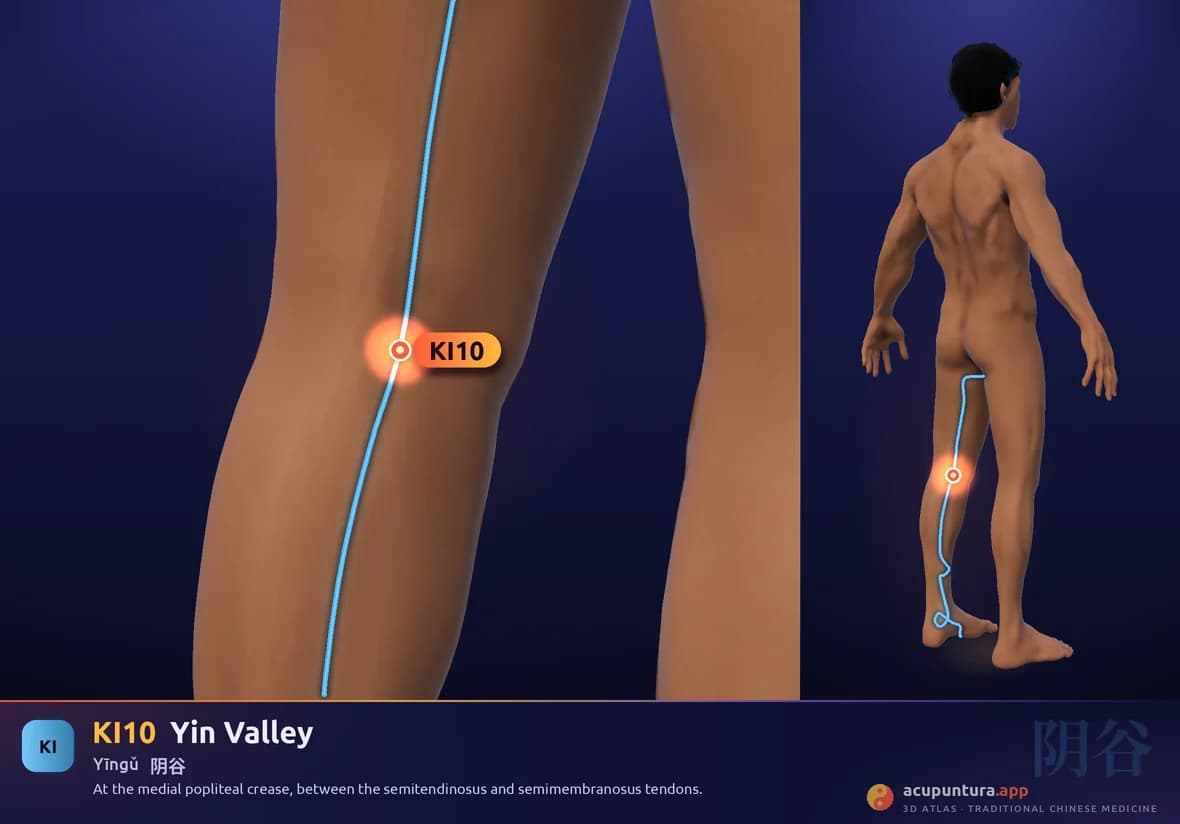
At the medial popliteal crease, between the semitendinosus and semimembranosus tendons.
Main function
Tonifies the Kidney, regulates the Lower Jiao, strengthens the lumbar region, benefits urination and the reproductive organs.
- He-Sea point (Water)
Therapeutic indications
- Low back pain
- dysuria
- enuresis
- dysmenorrhea
- impotence
- knee pain
- edema
- pain on the medial side of the knee
- hernia
- metrorrhagia
- mania
- hypogastric pain
Name and classical tradition
Yingu, 阴谷, is the “valley of Yin.” 阴 (陰) is Yin, the inner side; 谷 is the valley, the depression between muscles. The point lies on the inner side of the popliteal fossa, between two tendons, and the name describes it as a Yin valley. The modern gloss adds that the damp Qi of the channel gathers here.
The Lingshu (Spiritual Pivot), in the chapter Ben Shu (本輸), closes the channel's sequence with it: “入於陰谷,陰谷,輔骨之後,大筋之下,小筋之上也,按之應手,屈膝而得之,為合”. The Qi enters Yingu, behind the bone, below the large tendon and above the small one; you feel the pulsation on pressure, and you find it with the knee bent; it is the He-Sea point. On the Yin channels, the He-Sea point corresponds to Water, the same phase as the Kidney.
Its name is unmistakable among the many points with 谷: LI4, Hegu; SI5, Yanggu; or ST43, Xiangu, are on other channels and in other regions. On the outer side, along the same crease, is BL40, Weizhong.