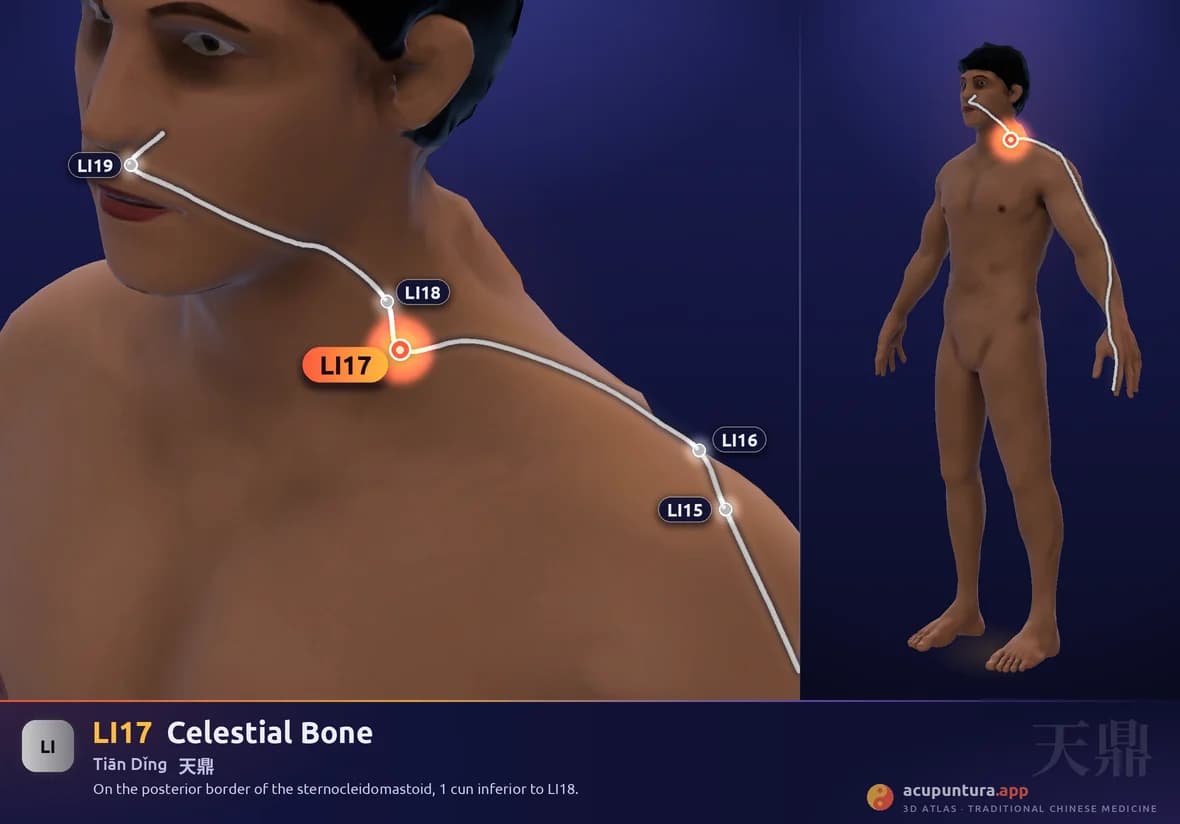
Large Intestine Channel
Celestial Bone
天鼎Tiān DǐngAnatomical location
On the posterior border of the sternocleidomastoid, 1 cun inferior to LI18.
Main function
Benefits the throat, disperses Wind, relieves pain.
Therapeutic indications
- Sore throat
- hoarseness
- cough
- goiter
- Sudden loss of voice
- Dysphagia
- Scrofula
- Sensation of a lump in the throat
Name and classical tradition
Tianding, 天鼎, is the "cauldron of heaven." 天 points, as in so many names, to the upper part of the body, here the neck. 鼎 is the ritual bronze tripod of ancient China, the three-legged vessel in which offerings were cooked, an emblematic object of dynastic power. There are two readings of the name. The anatomical one sees in the sternocleidomastoid muscle, with its two heads and the shape they form at the base of the neck, the legs of a tripod holding up the head. The functional one, which is modern, imagines the water of the channel heating in that cauldron and rising to the head as steam. The first is a reasonable description; the second is a gloss on the qi-vapor scheme with no citation.
The alternative names are 天頂, a homophonic variant, 天蓋, "canopy of heaven," and 天項, "nape of heaven." The sources trace the point to the Zhenjiu Jiayi Jing (Systematic Classic of Acupuncture and Moxibustion). No specific classical commentaries are known.