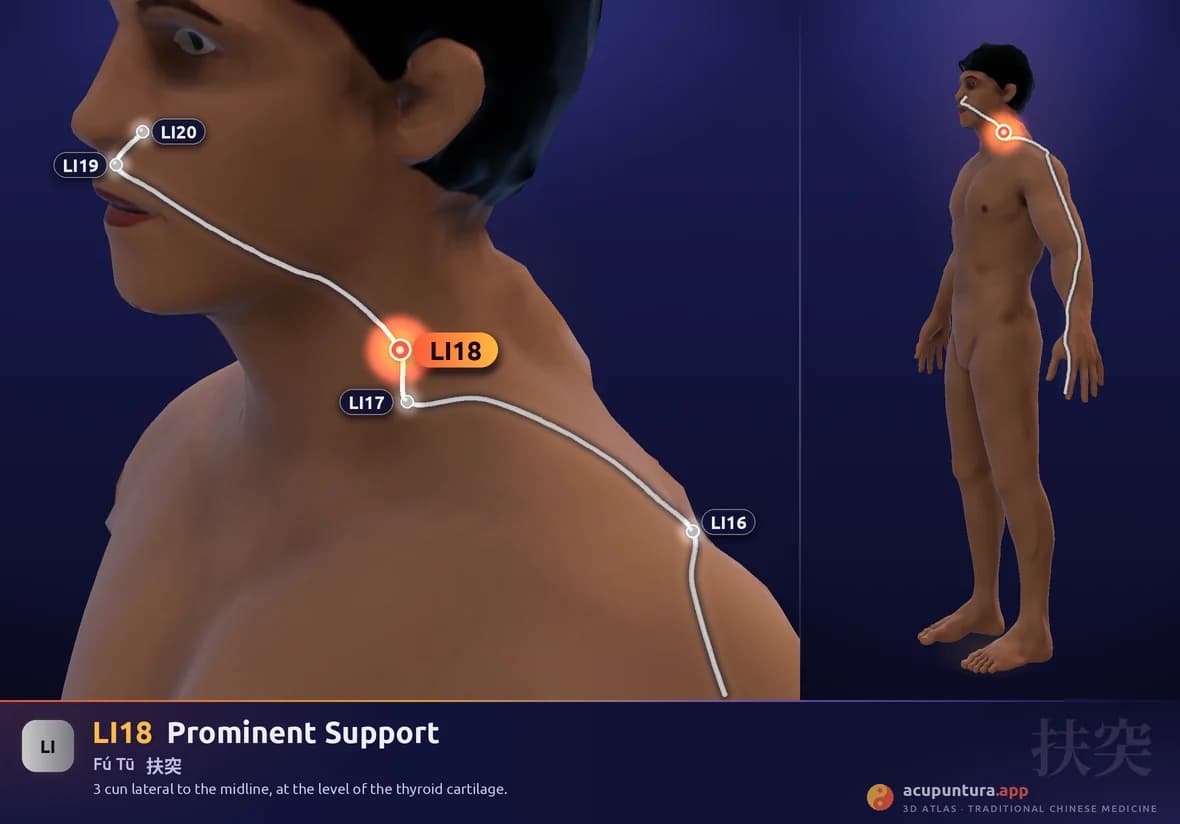
Large Intestine Channel
Prominent Support
扶突Fú TūAnatomical location
3 cun lateral to the midline, at the level of the thyroid cartilage.
Main function
Benefits the throat, disperses Wind, relieves pain.
- Window of Heaven point
Therapeutic indications
- Sore throat
- hoarseness
- cough
- goiter
- Loss of voice
- Asthma
- Scrofula
- Hiccups
- Hypertension
- Sensation of choking
- Hyperthyroidism
Name and classical tradition
Futu, 扶突, is one of the few points on the neck portion of the channel with an early mention. It appears in the Lingshu (Spiritual Pivot), and the Han Re Bing chapter (寒熱病) places it in relation to the neck musculature and the point ST9, Renying: «嬰筋之後,手陽明也,名曰扶突», behind the neck muscle, on the hand Yangming, is the point called Futu. The same chapter gives it a specific indication: «暴瘖氣鞭,取扶突與舌本出血», in sudden loss of voice with blocked breath, bleed Futu and the root of the tongue.
The name has two readings. In the first, 扶 means to support or to be beside, and 突 a prominence: Futu would be the point that accompanies the prominence of the larynx, and indeed it lies beside it. In the second, 扶 is understood as "on both sides," and the name would relate the point to the upper neck region where ST10, Shuitu, another "突," is also found. The anatomical reading appears to be the best supported.
The quotations were taken from secondary sources and should be checked against a critical edition. No alternative names are known for it.