Large Intestine Channel
Great Bone
巨骨Jù GǔAnatomical location
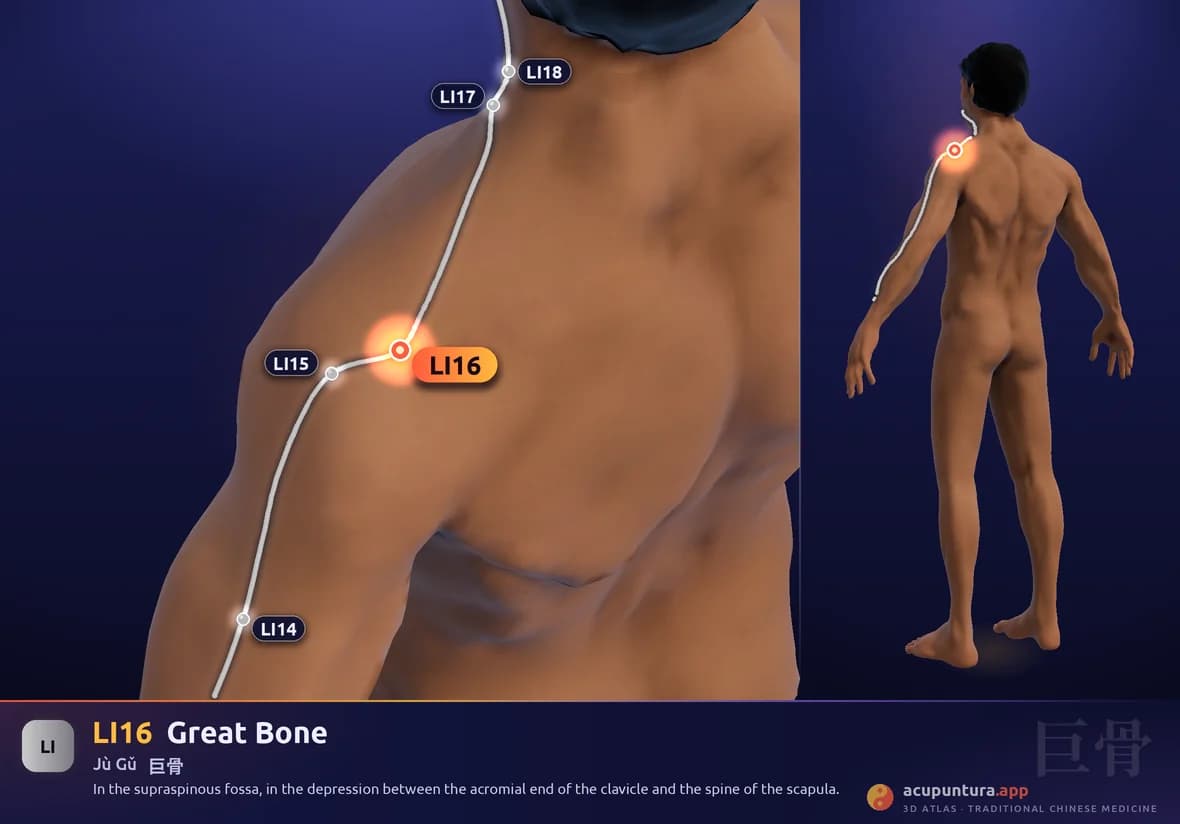
In the supraspinous fossa, in the depression between the acromial end of the clavicle and the spine of the scapula.
Main function
Unblocks the channel and relieves pain, benefits the shoulder joint, regulates Qi and Blood.
Therapeutic indications
- Shoulder and back pain
- difficulty raising the arm
- arm pain
- scrofula
- goiter
- Inability to raise the arm
- Hemoptysis
- Convulsions
- Clavicular pain
Name and classical tradition
Jugu, 巨骨, is the "great bone." The reading is direct: 巨 is great, 骨 is bone, and the point lies in the cleft between two large, prominent bones, the end of the clavicle and the spine of the scapula. The Zhenjiu Jiayi Jing (Systematic Classic of Acupuncture and Moxibustion) locates it «在肩端上行兩叉骨間陷者中», above the tip of the shoulder, in the depression between the two bones that fork apart. The quotation comes from a paraphrase and should be checked against the source. One modern source has proposed a reading in which the bone would allude to water within a scheme of qi and blood, a forced reading that the simplicity of the character makes unnecessary.
Contemporary Chinese encyclopedias attribute its origin to the Huangdi Mingtang Jing (Yellow Emperor's Bright Hall Classic), a treatise on points that is lost as an independent work, much of whose content survives within the Jiayi Jing. In practice, Huangfu Mi is the first source one can consult. Like LI15, it is a meeting point of the channel with the Yangqiao vessel. The term 巨骨 also appears in the Jiayi Jing as a reference for locating LU2, Yunmen, below the clavicle.