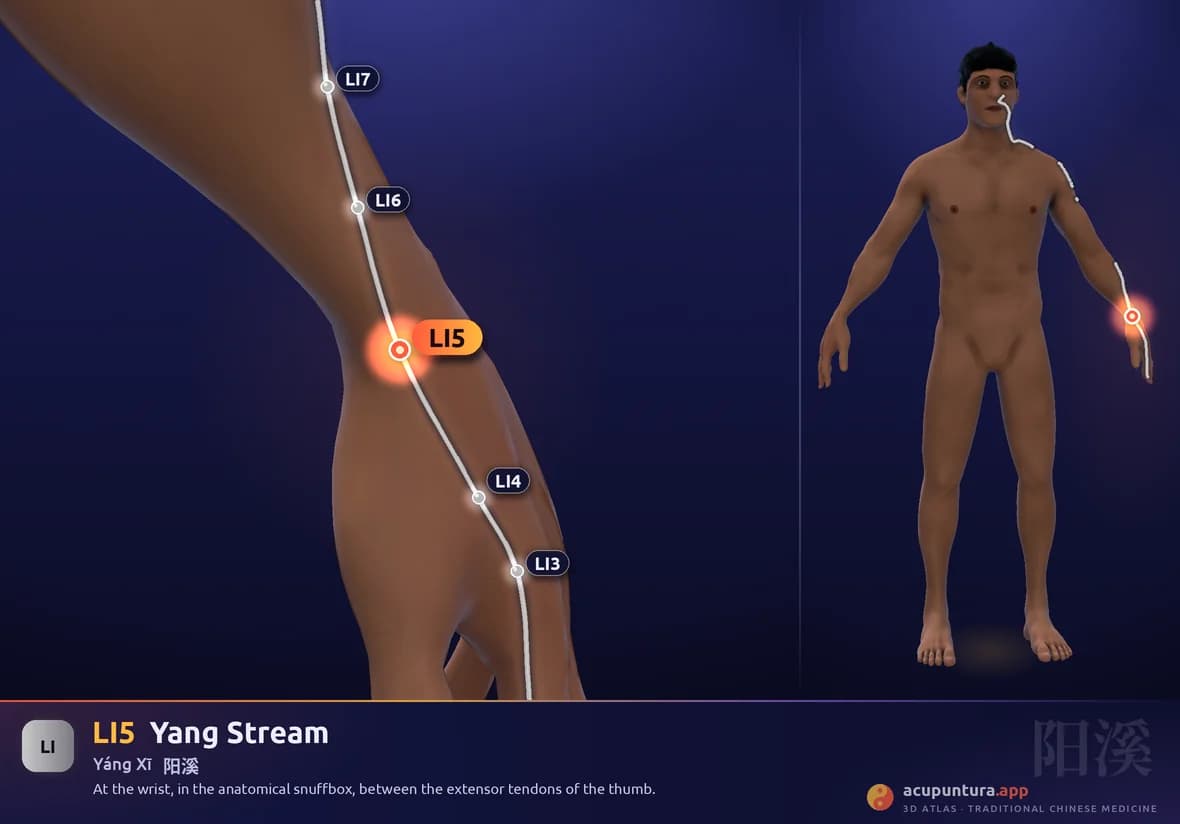
Large Intestine Channel
Yang Stream
阳溪Yáng XīAnatomical location
At the wrist, in the anatomical snuffbox, between the extensor tendons of the thumb.
Main function
Clears Heat, benefits the throat and ears, relieves pain.
- Jing-River point (Fire)
- Ryodoraku point H6 (Large Intestine)
Therapeutic indications
- Sore throat
- tinnitus
- wrist pain
- fever
- tendinitis of the radial styloid
- wrist pain and limited motion
- deafness
- red
- painful eyes
- headache
- thumb pain
- infantile indigestion
Ryodoraku
H6Intestino GruesoMeasurement point no. 2
Jing-River point, not the Yuan-Source point (LI4). It is Nakatani's representative point.
Name and classical tradition
Yangxi, 陽谿, is the “yang stream.” 陽 indicates the dorsal side of the hand, which is yang; 谿, also written 溪, is a stream or ravine, the word the nomenclature uses for narrow depressions between tendons or bones. Here the stream is the anatomical snuffbox, the hollow that forms at the wrist between the thumb tendons when the thumb is extended.
The Lingshu (Spiritual Pivot), chapter Ben Shu (本輸), describes it in those same terms: “行於陽谿,陽谿在兩筋間陷者中,為經.” The qi travels through Yangxi, in the depression between the two tendons; it is the Jing-River point (經穴). On the yang channels, the Jing-River point corresponds to Fire. After the “passing” at LI4, the verb is now “traveling,” the verb for the regular course of a river.
The Zhenjiu Jiayi Jing (Systematic Classic of Acupuncture and Moxibustion) gives it the alternative name 中魁, so the alias is ancient.
Other names
- 中魁Jiayi Jing