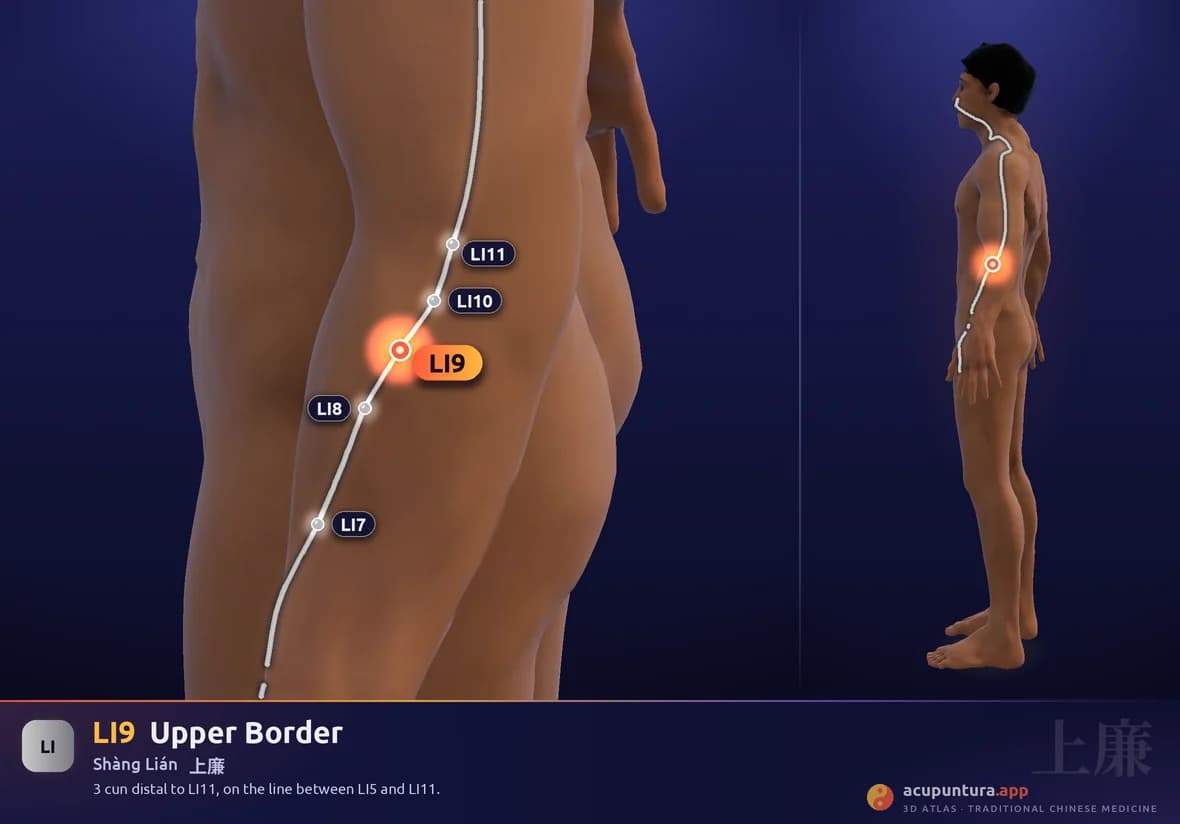
Large Intestine Channel
Upper Border
上廉Shàng LiánAnatomical location
3 cun distal to LI11, on the line between LI5 and LI11.
Main function
Regulates the Large Intestine, relieves forearm pain.
Therapeutic indications
- Abdominal pain
- diarrhea
- forearm pain
- numbness of the arm
- hemiplegia
- shoulder pain
- borborygmi
- difficulty flexing the elbow
Name and classical tradition
Shanglian, 上廉, is the “upper edge”: 上, above, and 廉, edge, ridge, a narrow, angular place. It forms a pair with LI8, the “lower edge,” and the two names order two neighboring points on the forearm along the same bony ridge. The Zhenjiu Jiayi Jing (Systematic Classic of Acupuncture and Moxibustion) records the alternative name 手上廉, “Shanglian of the hand,” to distinguish it from the Shanglian of the leg, ST37, Shangjuxu, on the Stomach channel. It is the same homonym problem its partner has.
The Huiyuan Zhenjiu Xue, a twentieth-century work of systematization, offers an ingenious gloss: “上廉者,廉者潔也,內廉外廉之間,陽明清陽之氣所會也……居下廉之上,故名上廉.” It plays on the homophony between 廉 and 潔, “clean”: it would be the place, between the inner and outer edges, where the clear yang of the Yangming gathers, and it is called “upper” because it sits above Xialian. This is the reading of one particular author, not of the classical tradition, and it should be taken as such.