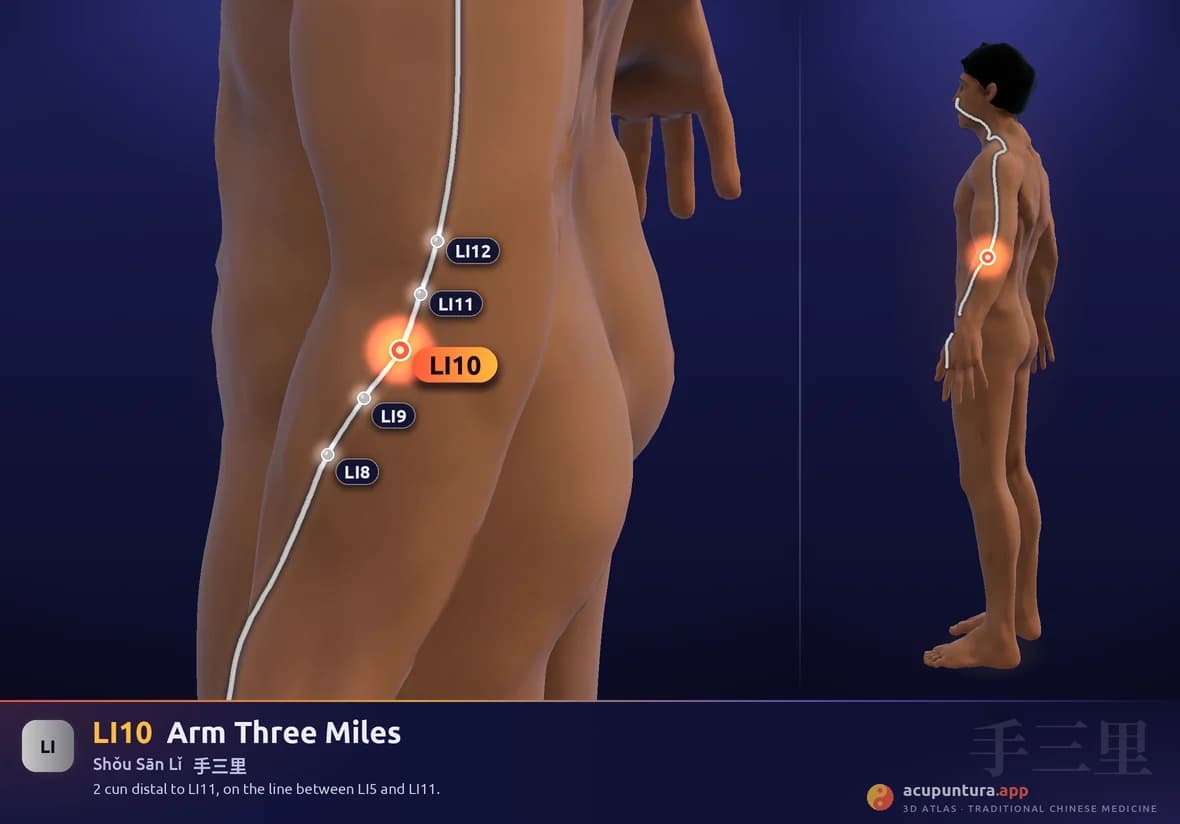
Large Intestine Channel
Arm Three Miles
手三里Shǒu Sān LǐAnatomical location
2 cun distal to LI11, on the line between LI5 and LI11.
Main function
Regulates the Large Intestine, strengthens Qi, relieves pain.
Therapeutic indications
- Abdominal pain
- diarrhea
- arm pain
- epicondylitis
- paralysis of the upper limb
- neck pain
- shoulder pain
- facial paralysis
- edema of the arm
- indigestion
Name and classical tradition
Shousanli, 手三里, is the “Sanli of the hand,” and its name is understood by comparison with the one on the leg, ST36, Zusanli. 三里 means “three li,” a unit of distance; 手 was added to distinguish it from its Stomach homonym. References also record the form 上三里, “upper Sanli,” which expresses the same contrast, and the name without a prefix, 三里.
The analogy has limits. For the Sanli of the leg, the Suwen (Basic Questions) gives a measurement: “所謂三里者,下膝三寸也,” three cun below the knee. That quotation does not apply to the arm. Shousanli lies two cun from LI11, Quchi, and not three li from any obvious joint landmark. The most likely explanation is that the name was given by parallel with Zusanli rather than by a literal measurement, although that hypothesis has not been checked against the Zhenjiu Jiayi Jing (Systematic Classic of Acupuncture and Moxibustion), the first work to record it.
Another alternative name, 鬼邪, “evil of the spirits,” comes from Sun Simiao's Qianjin Yaofang (Essential Formulas Worth a Thousand Gold), which writes “三里主之(一名鬼邪)” without saying which Sanli is meant; the alias has been attributed both to this point and to ST36.