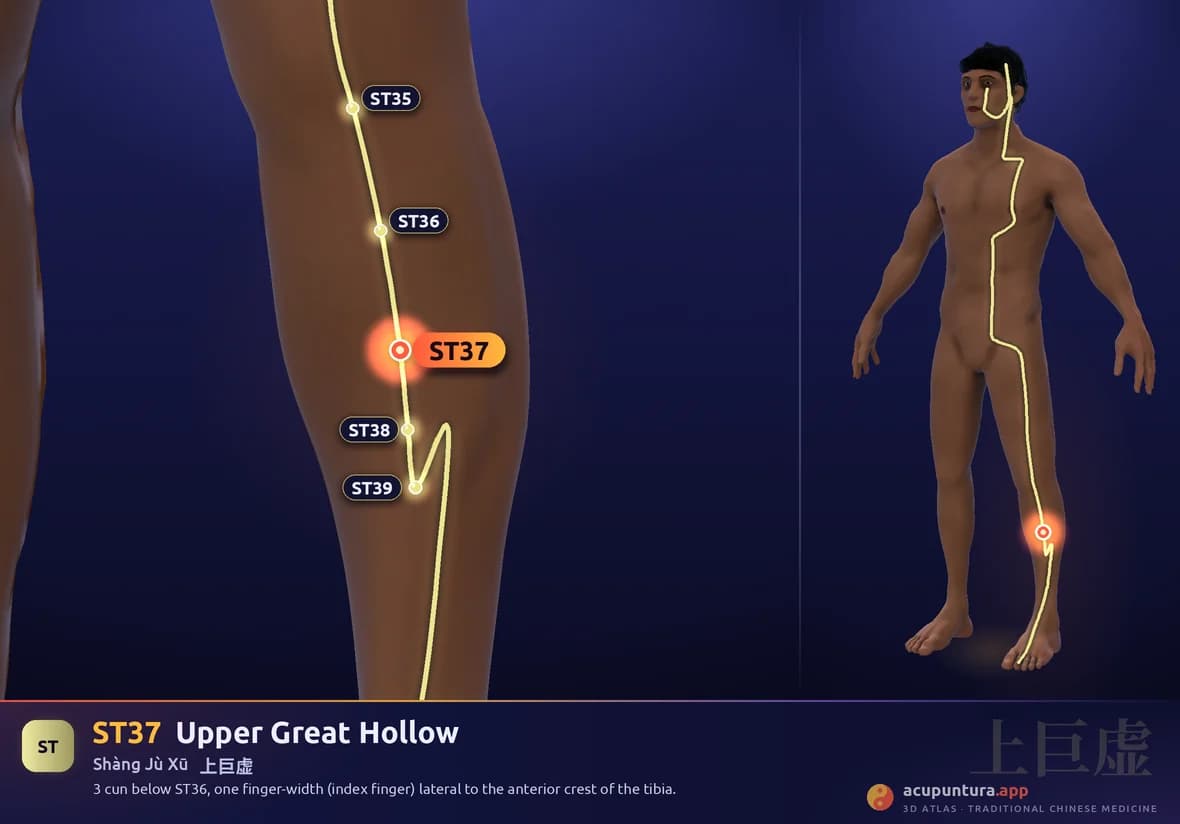
Stomach Channel
Upper Great Hollow
上巨虚Shàng Jù XūAnatomical location
3 cun below ST36, one finger-width (index finger) lateral to the anterior crest of the tibia.
Main function
Regulates the Large Intestine, eliminates Damp-Heat, relieves abdominal pain.
- Lower He-Sea point of the Large Intestine
Therapeutic indications
- Abdominal pain
- diarrhea
- dysentery
- constipation
- appendicitis
- borborygmi
- paralysis of the lower limb
- beriberi
- irritable bowel syndrome
- ulcerative colitis and Crohn’s disease
Name and classical tradition
Shangjuxu, 上巨虚, is the “upper great void.” 巨虛 designates the broad hollow between the tibia and the fibula, where the point lies when the foot is dorsiflexed; 上 distinguishes it from ST39, the lower great void. The reading is anatomical and coherent.
Its original name was different. The Lingshu (Spiritual Pivot), in the Ben Shu chapter, calls it 巨虛上廉, “upper edge of the great void.” The current abbreviated form, 上巨虛, has been attributed to Sun Simiao's Qianjin Yifang (Supplementary Formulas Worth a Thousand Gold) of the Tang period, although the citation has not been confirmed. The old name explains a frequent confusion with LI9, Shanglian, the “upper edge” of the arm, which is a different point.
The most important piece of evidence comes from the Lingshu, in the chapter Xie Qi Zang Fu Bing Xing (邪氣臟腑病形), which establishes the lower He-Sea points of the Fu organs: «胃合入於三里,大肠合入于巨虛上廉,小腸合入于巨虛下廉». The Stomach unites at Sanli; the Large Intestine, at the upper edge of the great void; the Small Intestine, at the lower edge. Shangjuxu is therefore the Lower He-Sea point (下合穴) of the Large Intestine, and so a point on the Stomach channel acts on another Fu organ.