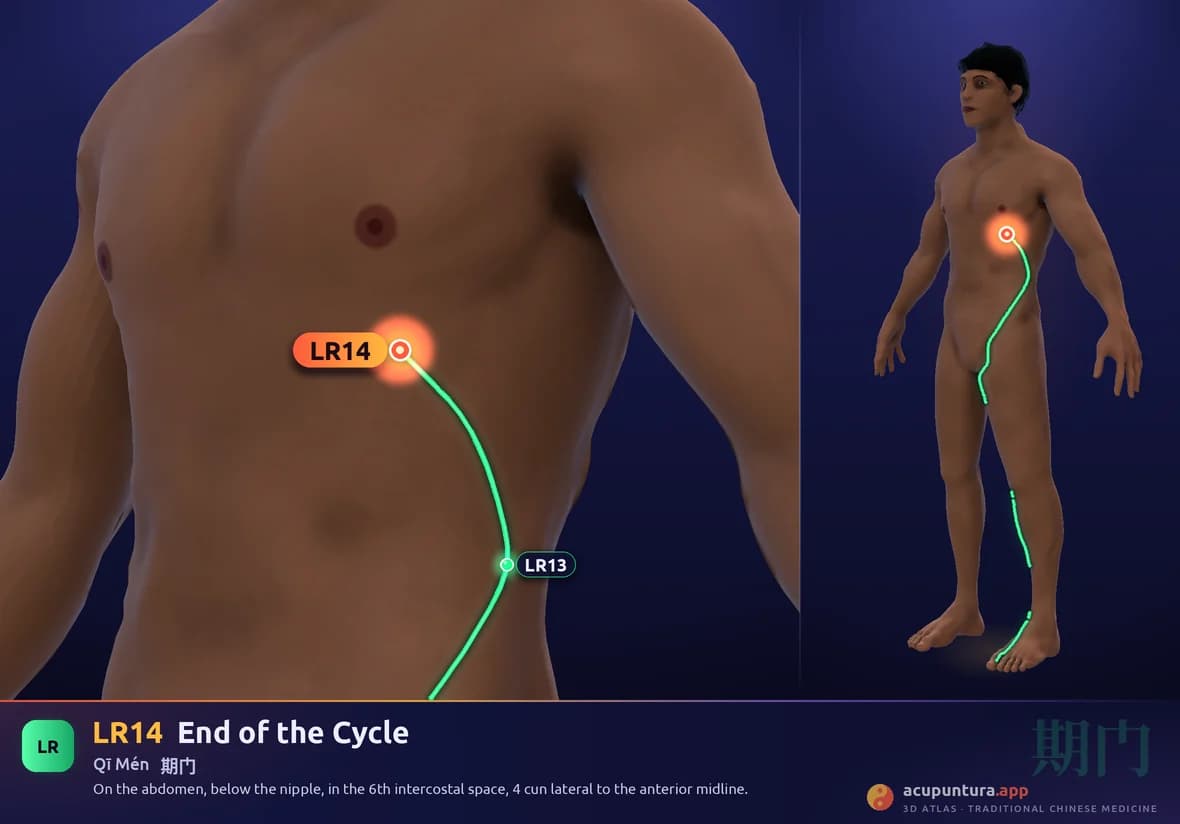
Liver Channel
End of the Cycle
期门Qī MénAnatomical location
On the abdomen, below the nipple, in the 6th intercostal space, 4 cun lateral to the anterior midline.
Main function
Front-Mu point of the Liver, regulates the Liver, harmonizes the Stomach, descends rebellious Qi, resolves Dampness.
- Front-Mu point of the Liver
- Crossing point with the Spleen
Therapeutic indications
- Hypochondriac pain
- abdominal distension
- jaundice
- nausea
- hiccups
- chest oppression
- irritability
- costal pain and fullness
- hepatitis
- cholecystitis
- vomiting
- reflux
- mastitis
- depression
- chest distension
- postpartum fever
- premenstrual syndrome
Name and classical tradition
Qimen, 期门, is the “gate of the cycle.” 期 is the term, the period, the appointment kept on time; 门, the gate. The most accepted reading rests on the point’s place in the system: in the classical order of circulation, Qi runs through the twelve channels beginning at the Lung and ending at the Liver, and Qimen is the last point of that circuit. The Jinnang Milu (Secret Records of the Brocade Bag) puts it this way: the circulation leaves through LU2, Yunmen, and ends in the Foot Jueyin to enter Qimen. Qimen would be the gate where the cycle is completed. Other glosses that speak of waiting and expectation seem to be poetic interpretations with no basis.
The point was already known in the Han period. Zhang Zhongjing’s Shanghan Lun (Treatise on Cold Damage) prescribes it several times, always with the same formula, “刺期門,” needle Qimen. For example, in the woman who contracts a wind disorder just as her period arrives and, once the fever subsides, feels fullness below the chest and becomes delirious: “此為熱入血室也,當刺期門,隨其實而取之”, the Heat has entered the chamber of the Blood; Qimen must be needled according to the excess. And in abdominal fullness with delirium and a wiry pulse: “此肝乘脾也,名曰縱,刺期門”, the Liver is overacting on the Spleen; this is called zong; needle Qimen. The Shanghan Lun does not give its location, but it uses it as something well known.
Qimen is the Front-Mu point (募穴) of the Liver and a crossing point of the Liver, the Spleen, and the Yin Wei Mai.