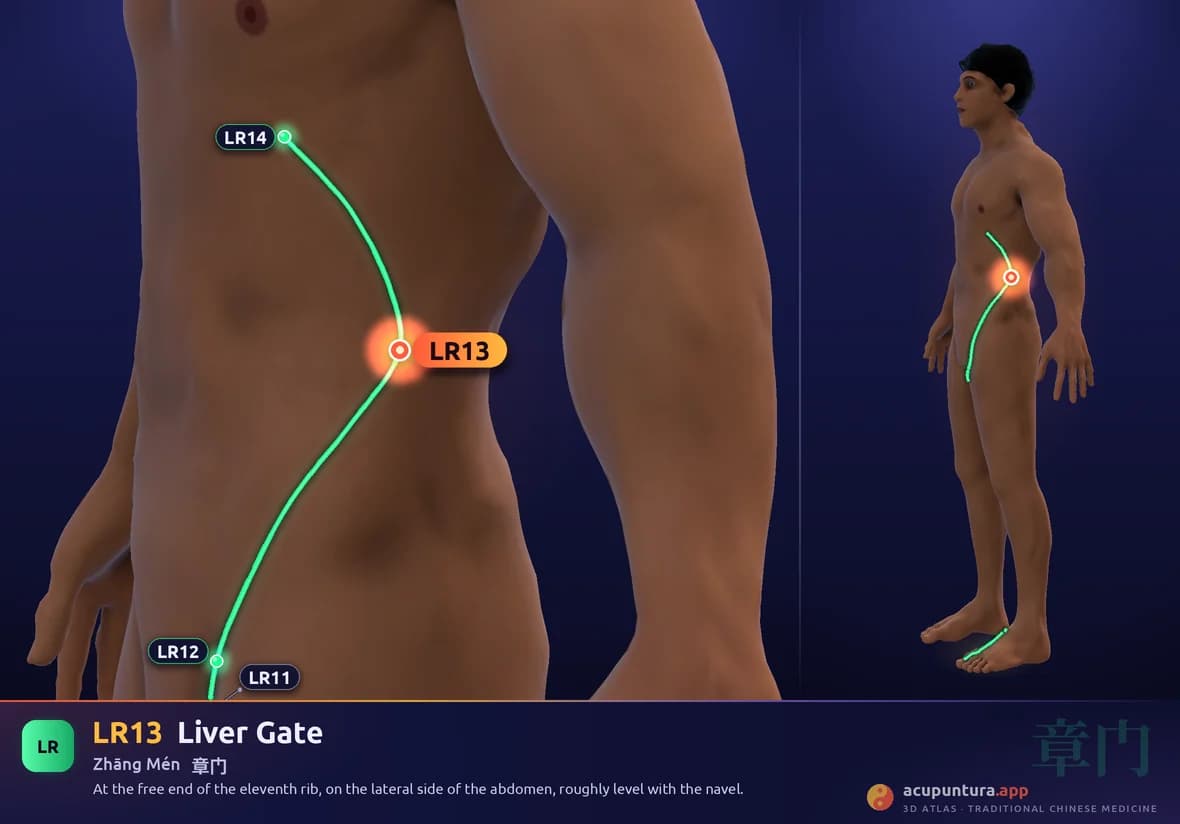
LR13

Liver Channel

Liver Gate

章门Zhāng Mén

Anatomical location

At the free end of the eleventh rib, on the lateral side of the abdomen, roughly level with the navel.

Main function

Influential (Hui) point of the Zang organs, regulates the Liver and Spleen, harmonizes the Stomach, promotes digestion, resolves Dampness.

  • Front-Mu point of the Spleen
  • Influential (Hui) Point of the Zang Organs
  • Crossing Point with the Gallbladder

Therapeutic indications

  • Hypochondriac pain
  • abdominal distension
  • jaundice
  • nausea
  • vomiting
  • diarrhea
  • abdominal masses
  • fatigue
  • indigestion
  • costal pain
  • hepatomegaly
  • splenomegaly
  • borborygmi
  • weight loss
  • depression
  • irritable bowel syndrome
  • fatty liver

Name and classical tradition

Zhangmen, 章门, is the “gate of protection,” if we accept that 章 stands here for 障, the barrier, the screen. Modern glosses propose that equivalence: the point lies below the free end of the eleventh rib, which protects the flank, and it would be the gate that guards the viscera. The equivalence has not been verified in an ancient philological source. 门 is the gate, a very common word in points that mark the entrance of the Qi of the organs.

Its history of names is long. According to the sources, the Zhenjiu Jiayi Jing (Systematic Classic of Acupuncture and Moxibustion) records it as 長平 or 脅髎; Sun Simiao’s Qianjin Yifang (Supplementary Prescriptions Worth a Thousand Gold) uses 脾募, the Mu point of the Spleen, and the Zhenjiu Daquan (Complete Compendium of Acupuncture and Moxibustion), in the Ming period, 季脅, the “final rib.” None of these quotations has been checked.

Zhangmen combines several roles. It is the Front-Mu point (募穴) of the Spleen. It is a crossing point of the Liver with the Gallbladder. And it is one of the eight Influential points listed in the Nanjing (Classic of Difficulties), Difficulty 45: the meeting point of the organs, “臟會季脅.” The Nanjing phrase names it with the alias 季脅, which confirms that this name is ancient.

Other names

  • 長平Jiayi Jing
  • 脅髎Jiayi Jing
Location of point LR13, Liver Gate
CC BY-ND 4.0 (opens in a new tab)
View point on the 3D modelLR13 on the anatomy
Needling techniqueOblique insertion 0.5-0.8 cun in a medial or inferior direction. Avoid deep needling.
Depth0.5-0.8 cun
MoxibustionApplicable with caution (3-5 cones or 5-10 minutes)

Classical combinations · 1

  • The Eight Influential Points八会穴Bā Huì XuéInfluential (Hui) point of each substance or tissue: Zang LR13, Fu CV12, Qi CV17, Blood BL17, tendons GB34, vessels LU9, bones BL11, marrow GB39.

Basic formulas from the vademecum · 3

View the vademecum

Named functional sets from the school: here the point does not act on its own, but through the role it plays within the maneuver.

  • Influential Point of the Zang OrgansInfluential (Hui) point of the Zang organs: it summons all five organs at once. Add it when the imbalance is no longer in a single organ but in the whole set.
  • Tonify the Middle EnergizerThe two Mu points (CV12 for the Stomach, LR13 for the Spleen) with their two Back-Shu points (BL21 and BL20): the Shu-Mu technique applied to the entire Spleen-Stomach axis.
  • Tonify the BloodPregnancyCovers the three sources of Blood: it is produced in the Center (LR13, Influential point of the organs), gathered at BL17 (Influential point of Blood) and SP10, rooted in the Kidney (BL52, home of the Zhi, and CV4), and driven from LU9, the Influential point of the vessels. SP6 stitches the whole together.
Cover of the guide “Protocols for the 20 most common patterns”

Free guide · PDF

Protocols for the 20 patterns you see most in practice

Each pattern with its tongue, its pulse, the treatment principle and the points to tonify and disperse. Made for the treatment table, not the bookshelf.

Do you use LR13 with your patients?

In the Clinic you record it in the patient's file, next to the tongue, the pulse and the measurements, so at the next session you know exactly what you used. The Atlas is built in.

See the Clinic