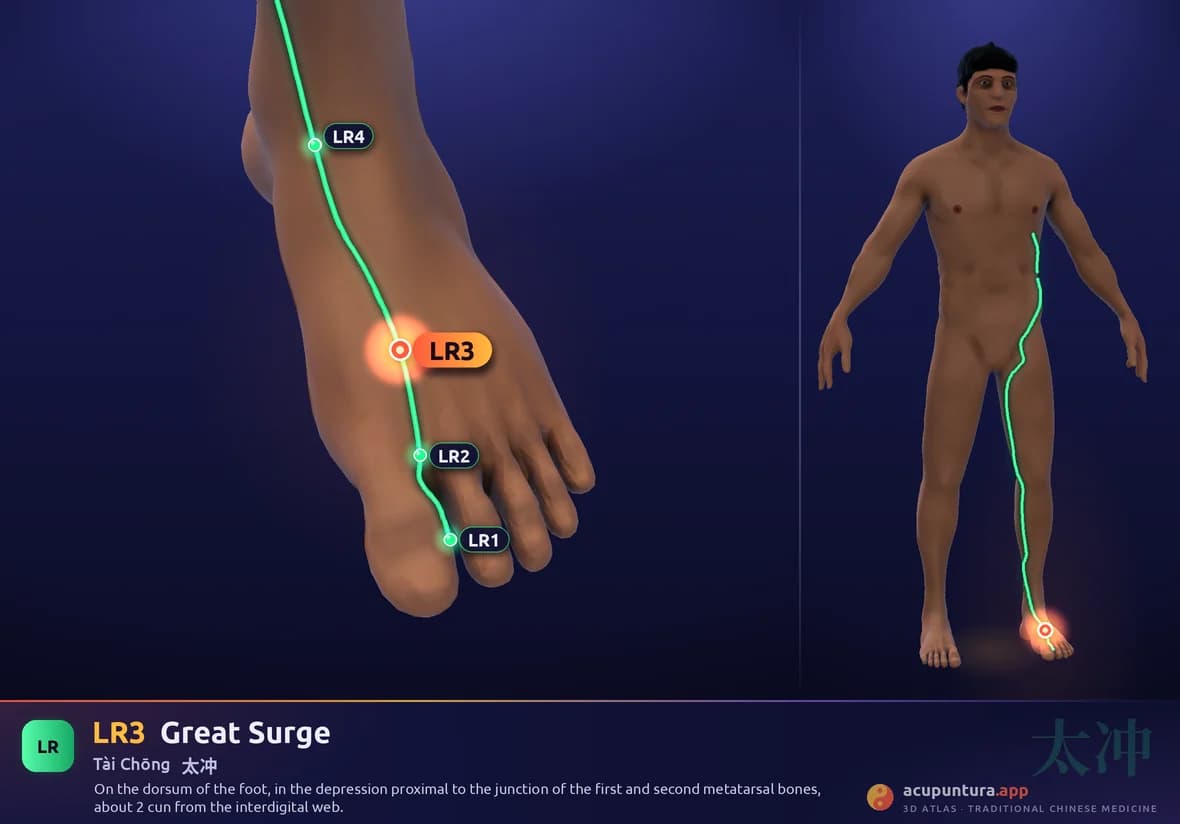
Liver Channel
Great Surge
太冲Tài ChōngUse caution during pregnancy
Strongly moves Liver Qi and descends. Avoid intense stimulation; many authors exclude it during pregnancy.
Anatomical location
On the dorsum of the foot, in the depression proximal to the junction of the first and second metatarsal bones, about 2 cun from the interdigital web.
Main function
Shu-Stream point (Earth), Yuan-Source point, regulates the Liver, harmonizes Qi and Blood, calms Internal Wind, benefits the eyes and the Shen.
- Yuan (Source) point
- Shu-Stream point (Earth)
- Ryodoraku point F2 (Liver)
Therapeutic indications
- Headache
- vertigo
- hypertension
- insomnia
- anxiety
- dysmenorrhea
- jaundice
- muscle spasms
- convulsions
- Cephalalgia
- Red eyes
- Irritability
- Depression
- Amenorrhea
- Premenstrual breast pain
- Rib-side pain
- Hernia
- Enuresis
- Urinary retention
- Cramps
- Foot pain
- Premenstrual tension
- Bipolar disorder (Dian-Kuang alternation)
- Panic attacks (Ben Tun Qi)
- Post-traumatic stress
- Obsessive disorder (ruminative thinking)
- Parkinson's disease (tremor due to Internal Wind)
- Multiple sclerosis (Wei pattern)
- Fibromyalgia
- Tension headache
- Ménière's disease
- Addictions and smoking cessation
- Bruxism
- Obesity and overweight
- Hyperlipidemia (high cholesterol and triglycerides)
- Hyperuricemia and gout
- Hyperthyroidism
- Irritable bowel syndrome
- Fatty liver
- Gallstones and biliary colic
- Gastroesophageal reflux
- Polycystic ovary syndrome
- Endometriosis
- Premenstrual syndrome
- Psoriasis
- Acne
- Herpes zoster and postherpetic neuralgia
Ryodoraku
F2HígadoMeasurement point no. 12
Liver Yuan-Source point, between the 1st and 2nd metatarsals.
Name and classical tradition
Taichong (太冲) is the “great thoroughfare” or the “great confluence.” 太 is great, supreme; 冲 (衝), the main thoroughfare, the place of great transit, the same character as in Chong Mai (Penetrating Vessel), the “penetrating” vessel. The consensus reading is that the original Qi of the Liver rises through here, and it is one of the names whose etymology holds up without needing modern glosses.
The Lingshu (Spiritual Pivot), in the chapter Ben Shu (本輸), locates it this way: “注於太衝,太衝,行間上二寸陷者之中也,為俞”. Qi pours into Taichong, in the depression two cun above Xingjian; it is the Shu-Stream point. The chapter Jiu Zhen Shi Er Yuan (九針十二原) gives it its other role: “陰中之少陽,肝也,其原出於太衝”: the Liver is the Shaoyang within the Yin, and its Yuan-Source point is at Taichong. On the Yin channels, Shu and Yuan coincide and correspond to Earth. It shares 太 with the Yuan-Source points of the other Yin organs, such as LU9, SP3, and KI3.
The reference works record the variant 大衝, with 大 in place of 太, a common exchange in ancient texts. Although it shares the 冲, it has no relation to other points such as ST30, Qichong, GB9, Tianchong, or the Jing-Well points of the hand, PC9, TE1, and HT9.