Lung Channel
Great Fish
鱼际Yú JìAnatomical location
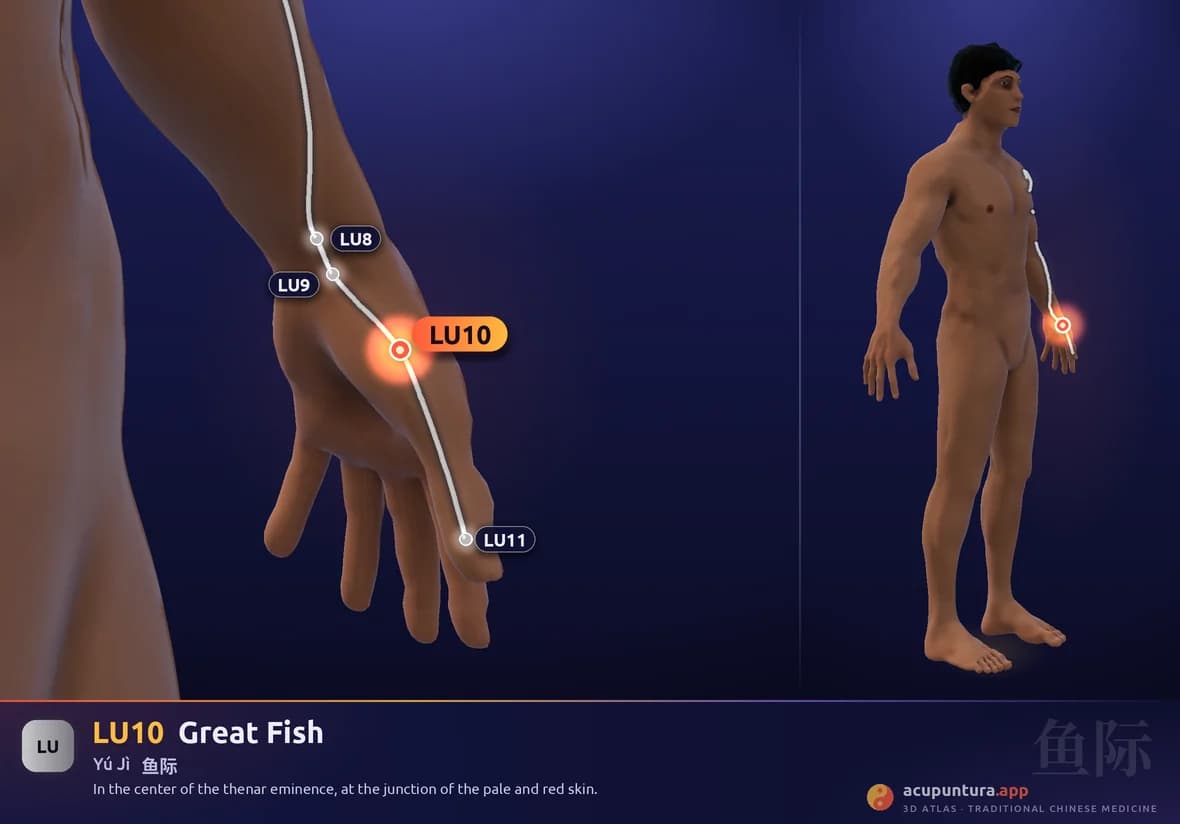
In the center of the thenar eminence, at the junction of the pale and red skin.
Main function
Clears Lung Heat, benefits the throat.
- Ying-Spring Point (Fire)
Therapeutic indications
- Fever
- cough
- sore throat
- loss of voice
- hemoptysis
- heat in the palms
- sweating of the hands
- thumb pain
- mastitis
- dry throat
- faint voice
Name and classical tradition
Yuji, 魚際 (鱼际), is the «border of the fish.» It is a purely descriptive name, and one of the few on which the tradition has agreed without dissent for more than a thousand years. The fish is the thenar eminence, the fleshy mound at the base of the thumb. The Huangdi Neijing Mingtang, in Yang Shangshan's commentary, puts it this way: «大指本節後象彼魚形,故以魚名之», behind the joint of the thumb there is a shape that looks like a fish, and hence the name.
際 supplies the second half of the image. Reference works gloss it as the place where two surfaces meet, «凡兩合皆曰際», and in the hand that meeting is between the red skin of the palm and the white skin of the back of the hand. The same commentary states it precisely: «赤白肉畔,故曰魚際», it lies on the boundary between the red flesh and the white. The point sits right at the edge of the fish.
In the system of the five transport points set out in the Lingshu (Spiritual Pivot), Ben Shu chapter (本輸), Yuji is the Ying-Spring point (滎穴) of the Lung, the second after LU11. What is notable is the continuity of its location across the centuries. The Zhenjiu Jiayi Jing (Systematic Classic of Acupuncture and Moxibustion) places it «手大指本節後內側散脈中», on the inner side, behind the joint of the thumb, among scattered vessels. The Zhenjiu Yulong Jing, from the Yuan period, describes it with the finger flexed; the Shenying Jing, Ming, returns to the border of the white flesh, and the Xunjing Kaoxue Bian brings it to about one cun from the crease. The way of measuring changes, but the image of the fish and its edge remains the same.