Lung Channel
Great Abyss
太渊Tài YuānAnatomical location
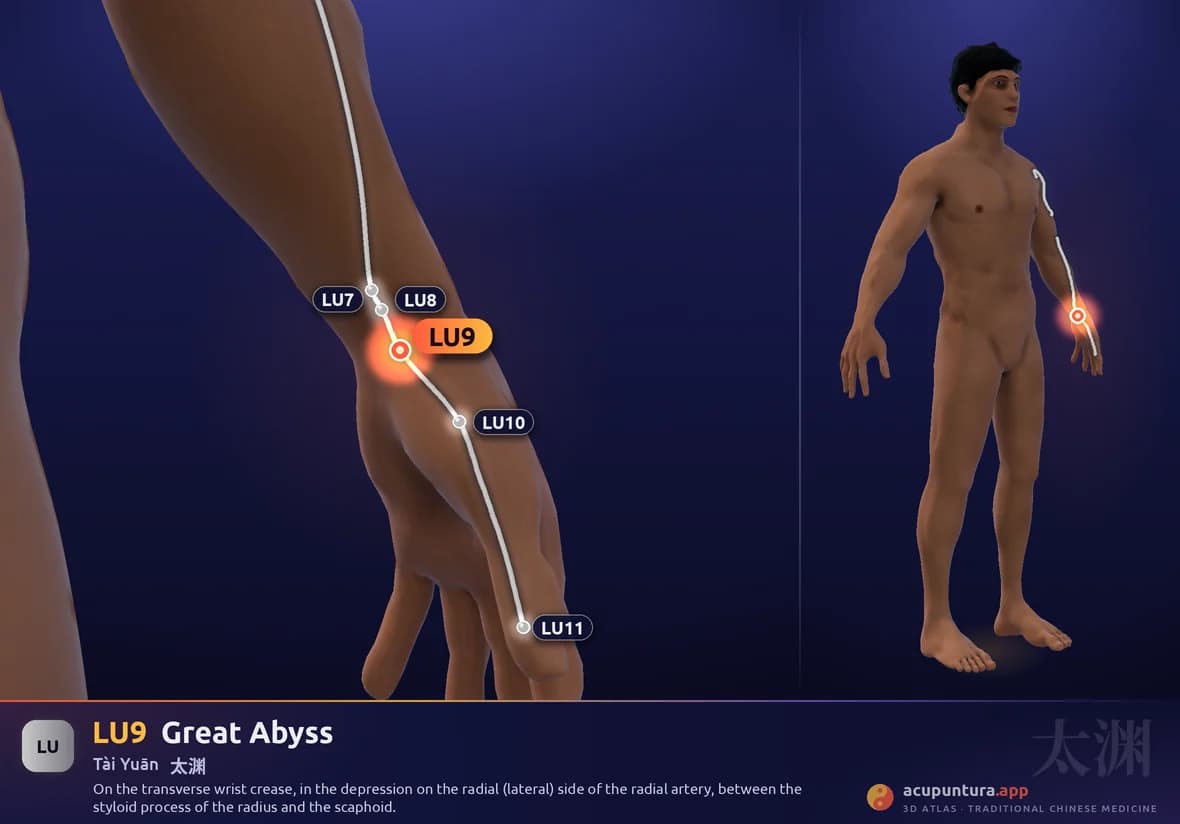
On the transverse wrist crease, in the depression on the radial (lateral) side of the radial artery, between the styloid process of the radius and the scaphoid.
Main function
Tonifies the Lung, regulates Qi, stops cough.
- Yuan (Source) point
- Shu-Stream point (Earth)
- Influential (Hui) point of the Vessels
- Tonification Point
- Ryodoraku point H1 (Lung)
Therapeutic indications
- Cough
- asthma
- sore throat
- wrist pain
- hemoptysis
- absent or weak pulse
- palpitations
- chest pain
- fatigue
- intercostal pain
- dry throat
- red
- bloodshot eyes
- vascular disorders
- COPD and chronic bronchitis
- low blood pressure
Ryodoraku
H1PulmónMeasurement point no. 1
Yuan-Source point of the Lung; on the radial artery, over the Cun Kou pulse.
- Tonification of Lung
Name and classical tradition
太淵, Taiyuan, combines 太, «great,» and 淵, «abyss» or deep water. The image is that of a deep pool, and it fits everything the point brings together: it is the Yuan-Source point (原穴) of the Lung, the Shu-Stream point (輸穴, Earth) among its five transport points and, since the Nanjing (Classic of Difficulties), the meeting point of the vessels. Difficulty 45 (四十五難) puts it in four characters, «脈會太淵», and the reason is plain to see: the point lies on the radial artery, at the cunkou (寸口), the classical site for taking the pulse.
The Lingshu (Spiritual Pivot) already fixes the root (本) of the hand Taiyin there, «在寸口之中», in the middle of the cunkou. Centuries later, the commentator Ma Shi (馬蒔), of the Ming period, adds the identification the text had not made explicit: that place is «即太淵穴», that is, Taiyuan. The location descriptions follow one another with few variations: the Lingshu speaks of the depression left behind the thenar eminence; the Zhenjiu Jiayi Jing (Systematic Classic of Acupuncture and Moxibustion), «在掌後陷者中», in the hollow behind the palm; and the Zhenjiu Zisheng Jing by Wang Zhizhong, already in the Song period, moves it to the end of the transverse wrist crease.
The most singular fact about the point is a change of name for reasons of state. During the Tang dynasty, the character 淵 was part of the personal name of the founder, Li Yuan (李淵), Emperor Gaozu, and the practice of name taboo (避諱) forbade writing it. The point then circulated as 大泉, «great spring»: the abyss became a source without changing the idea of abundant water. It is a typical case of 避諱, although the specific edition that records the change could not be located. Another of its names has a precise source. In the list of the thirteen ghost points in the Qianjin Yaofang (Essential Prescriptions Worth a Thousand Gold), the fourth is «掌後橫紋,名鬼心», the crease behind the palm, called Guixin, «heart of the ghosts,» and the edition itself notes «即太淵穴也», that is, Taiyuan. Reference works add 太泉 and 天泉, unverified in any primary text.
Other names
- 鬼心Qianjin Yaofang