Lung Channel
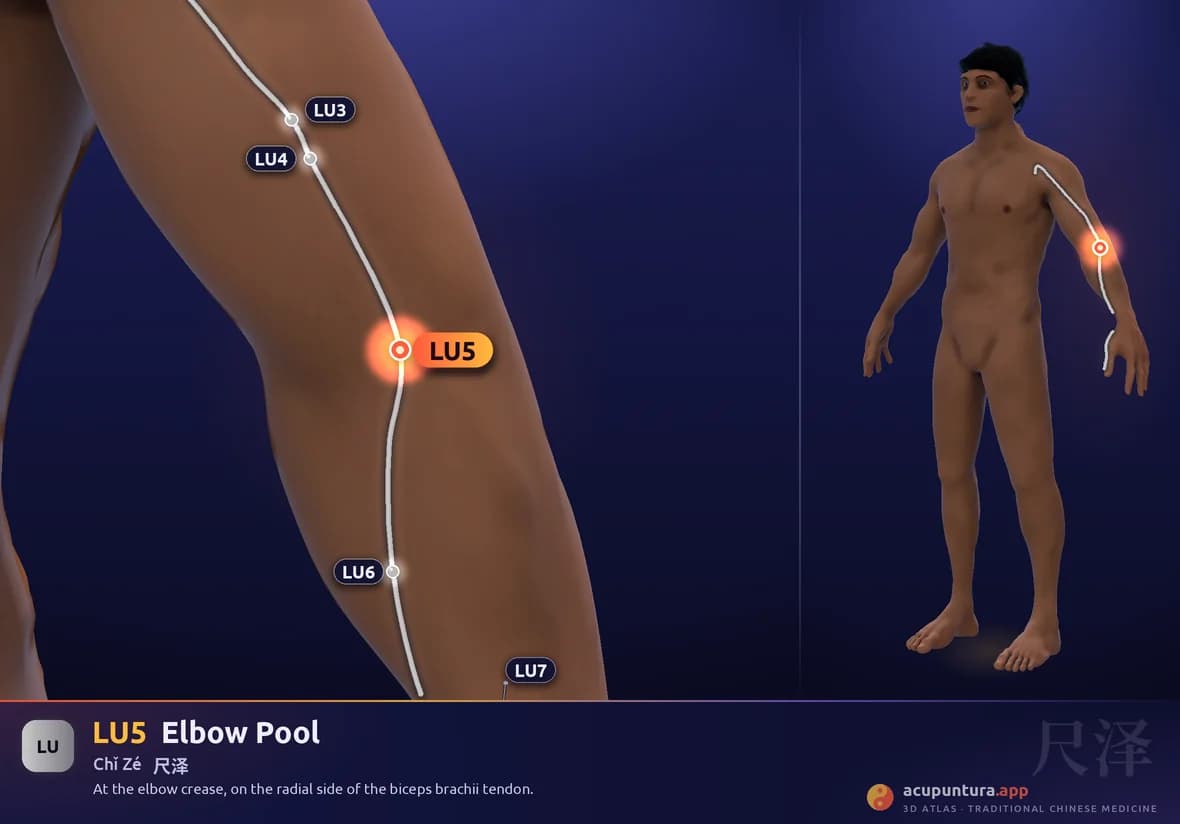
Elbow Pool
尺泽Chǐ ZéAnatomical location
At the elbow crease, on the radial side of the biceps brachii tendon.
Main function
Regulates the Lung, resolves Phlegm, relieves cough and asthma.
- He-Sea point (Water)
- Sedation Point
Therapeutic indications
- Cough
- asthma
- sore throat
- elbow pain
- hemoptysis
- afternoon fever
- dry throat
- chest fullness
- contracture and pain of the elbow
- forearm cramp
- vomiting
- acute diarrhea
- acute low back pain
- urinary incontinence
- Heat in the Lung
- COPD and chronic bronchitis
Ryodoraku
- Sedation of Lung
Name and classical tradition
Chize, 尺澤, is usually translated as "cubit marsh" or "elbow pool." 澤 is the marsh, the low ground where water pools. 尺 has been read in two ways: as the forearm, the region of the elbow, or as the unit of measurement of the same name, alluding to the point's distance within the system of body measurements. There is also a modern gloss that breaks the character down into 尸, "person," and a stroke that would draw the bent elbow. It is suggestive, but it has no classical support.
The name and the function appear together in the Lingshu (Spiritual Pivot), Ben Shu chapter (本輸): Chize is the He-Sea point (合穴) of the Lung, the last of its five Shu points and the one that corresponds to Water. Yang Shangshan, in the Huangdi Neijing Mingtang (Yellow Emperor's Inner Classic, Bright Hall Edition), explains the name from that function: the Qi and Blood of the channel arrive here and accumulate like water flowing into a marsh. The image of 澤 is therefore not decorative, but summarizes the point's place in the sequence.
The location texts follow one another across more than a millennium. The Zhenjiu Jiayi Jing (Systematic Classic of Acupuncture and Moxibustion) defines it this way: "尺澤者,水也。在肘中紋上動脈," Chize is Water, and it lies at the elbow crease, over the pulsation. The Tang-period Waitai Miyao (Secret Essentials from the Imperial Library) speaks of the gap between tendon and bone at the transverse crease, and the Ming-period Yixue Rumen (Introduction to Medicine) places it on the outside of the large tendon. The Xunjing Kaoxue Bian (Compilation on Channel Tracing and Point Study) adds a technique note: to needle it, the arm should be bent like a bow. In the Suwen, Ci Jin Lun chapter (刺禁論), Wang Bing comments on a passage about needling "in the middle of the flexion" that is usually connected with this location.
Sun Simiao's Beiji Qianjin Yaofang (Essential Prescriptions Worth a Thousand Gold for Emergencies), in the chapter he devotes to ailments "of the spirits," gives it a name of its own: "尺澤主之(尺中動脈一名鬼受)," it is treated with Chize, whose elbow pulsation is also called Guishou, "the one that receives the spirits." It is not among the thirteen main points of that list, but among the supplementary ones.
Other names
- 鬼受Qianjin Yaofang