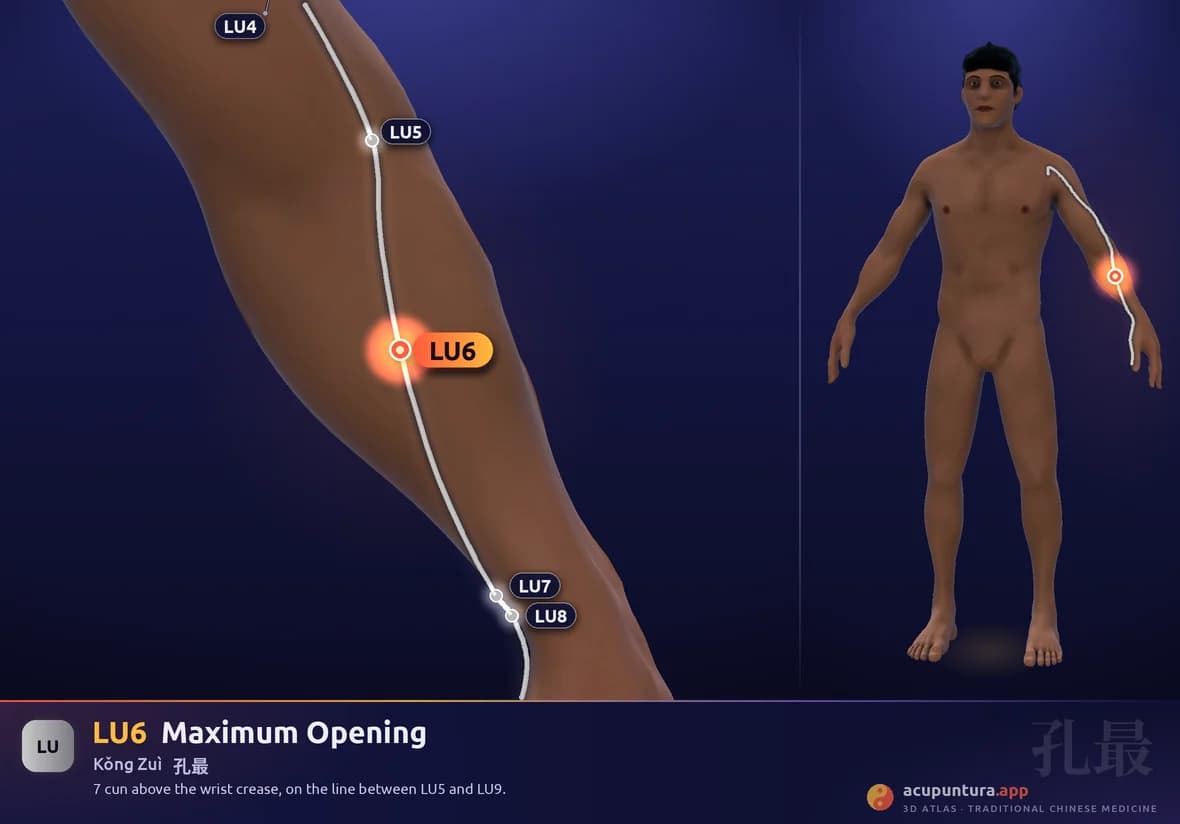
Lung Channel
Maximum Opening
孔最Kǒng ZuìAnatomical location
7 cun above the wrist crease, on the line between LU5 and LU9.
Main function
Stops bleeding, benefits the throat, relieves pain.
- Xi-Cleft point
Therapeutic indications
- Hemoptysis
- epistaxis
- sore throat
- arm pain
- bleeding hemorrhoids
- sudden loss of voice
- fever without sweating
- acute cough
- dyspnea
- pain in the elbow and forearm
Name and classical tradition
Kongzui, 孔最, combines 孔, "orifice" or "opening," and 最, "the utmost" or "the extreme." The simplest reading connects the name with the category of the point: it is the Xi-Cleft point (郄穴) of the Lung, and 郄 designates precisely a cleft, a narrow space where Qi and Blood accumulate in depth. Kongzui would thus be the cleft par excellence of the channel. It is a reading consistent with the theory, although no classical commentator wrote it down.
There is a more elaborate explanation in contemporary popular writing, according to which the water and Qi arriving from LU5 are filtered here toward the Earth of the Spleen, as though through a sieve with many openings, and 最 would indicate the maximum degree of that filtration. It is a construction of modern theory, with no classical citation to support it.
What is documented is more succinct. The Zhenjiu Jiayi Jing (Systematic Classic of Acupuncture and Moxibustion) by Huangfu Mi, in the third century, is the first work to record it, with a location given in a single measurement: "去腕七寸," 7 cun from the wrist. In the Qing period, Li Xuechuan specifies in the Zhenjiu Fengyuan (Sources of Acupuncture and Moxibustion) how to find it: "上骨下骨間陷中側取之," in the depression between the two bones of the forearm, taken from the side. No glosses by Yang Shangshan or Wang Bing dedicated to this point are known.