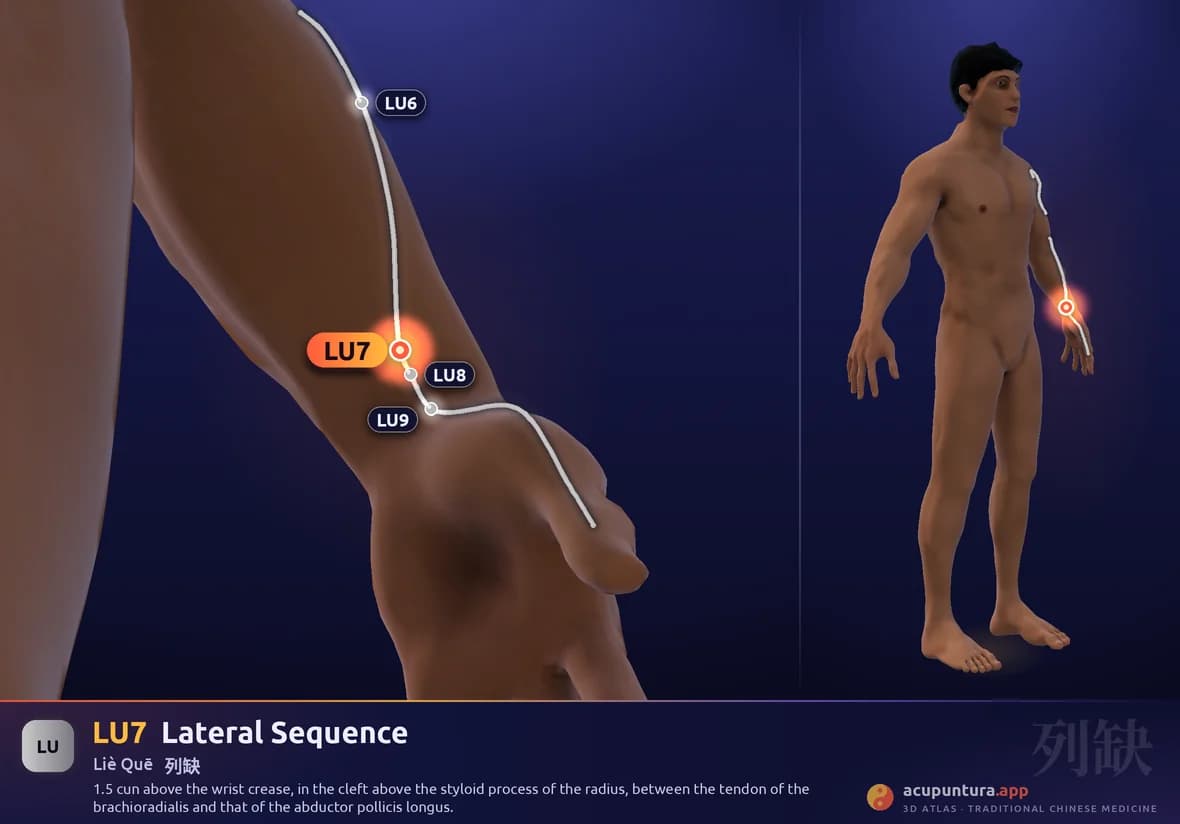
Lung Channel
Lateral Sequence
列缺Liè QuēAnatomical location
1.5 cun above the wrist crease, in the cleft above the styloid process of the radius, between the tendon of the brachioradialis and that of the abductor pollicis longus.
Main function
Regulates the head and neck, relieves pain, benefits the Lung.
- Luo (Connecting) point
- Opening Point of the Ren Mai
Therapeutic indications
- Headache
- stiff neck
- cough
- asthma
- sore throat
- common cold
- facial paralysis
- deviation of the mouth and eye
- toothache
- wrist pain
- polyuria
- enuresis
- dysuria
- memory loss
- sadness
- occipital pain and stiffness
- addictions and smoking cessation
- allergic rhinitis
Name and classical tradition
Few names in the Atlas hold as precise an image as 列缺, Lieque. In classical Chinese the expression doesn't belong to the vocabulary of medicine but to that of the sky: it is a name for lightning. The proof lies in Han poetry. Sima Xiangru, in his Great Man Rhapsody (大人賦), preserved in the Hanshu (Book of Han, 漢書), describes a flight through the heavens that «貫列缺之倒景», passes through the inverted reflection of Lieque, and the commentator Fu Qian glosses it bluntly: «列缺,天閃也», Lieque is the lightning of the sky. Yang Xiong, in his Ganquan Rhapsody, uses the same word beside thunder: «辟歷列缺,吐火施鞭», the crash and the lightning spit fire and crack like a whip.
Why a point on the wrist should receive this name is something no ancient text explains. One common reading, though without a classical citation to support it, starts from the fact that the Lung occupies the highest place in the trunk and is associated with the heaven of the body: the place where its channel opens toward another would be a crack in that vault. Alongside it lives a plainer anatomical reading, since the point is found in a cleft between tendons, over the styloid process of the radius.
What is canonical text is the function the Lingshu (Spiritual Pivot) assigns to it. In the Jing Mai chapter (經脈), the one that traces the channels and their collaterals, we read: «取之去腕半寸,別走陽明也», take it half a cun from the wrist, where it separates and runs toward the Yangming. The Zhenjiu Jiayi Jing (Systematic Classic of Acupuncture and Moxibustion), which copies the passage, gives instead «去腕一寸半», a cun and a half, the measurement that has prevailed: a genuine variant between ancient editions. It is the Luo-Connecting point (絡穴) of the Lung, the link with the Large Intestine. Yang Shangshan, in the Huangdi Neijing Taisu, glosses 缺 in this technical sense: the point marks the place where a branch departs from the main pathway.
Later tradition added two roles. It is one of the eight confluent points (八脈交會穴), the one that communicates with the Ren Mai. And it appears in the song of the four major points (四總穴歌) with the line «頭項尋列缺»: for the head and nape of the neck, look to Lieque. The other three lines divide the body among ST36, BL40, and LI4. Its storm partner is ST40, Fenglong, the lord of the clouds, who appears in the same Sima Xiangru poem, one line further down. Some modern reference works also attribute the aliases 童玄 and 裂缺 to it, with no precise classical source.