Pericardium Channel
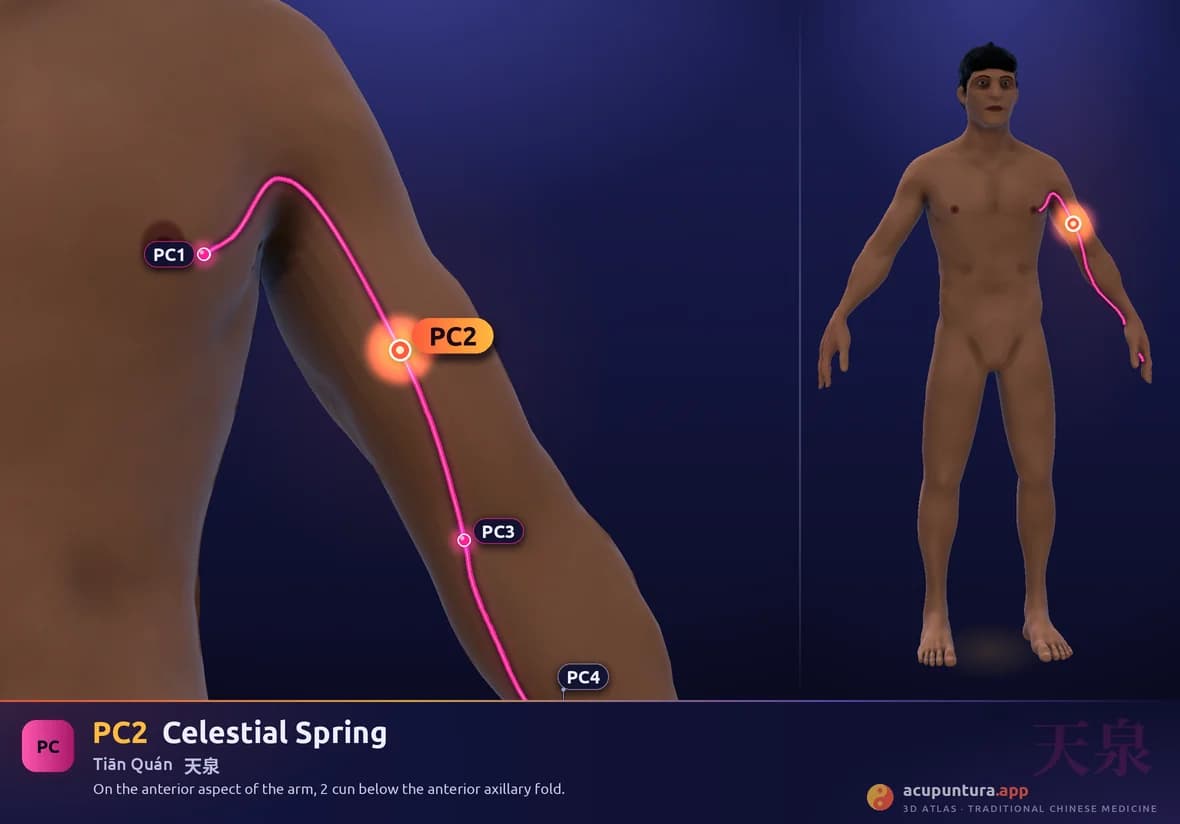
Celestial Spring
天泉Tiān QuánAnatomical location
On the anterior aspect of the arm, 2 cun below the anterior axillary fold.
Main function
Regulates Heart Qi, relieves pain in the arm and chest.
Therapeutic indications
- Chest pain
- palpitations
- arm pain
- back pain
- blurred vision
- pain on the medial aspect of the arm
- chest tightness
Name and classical tradition
Tianquan, 天泉, is the “heavenly spring”: 天, the heights, and 泉, the source. The point lies on the medial aspect of the arm, a little below the axillary crease, and its name continues that of PC1, the “heavenly pool.” According to a modern gloss, the water of Qi that accumulates at Tianchi would fall down to here like a spring descending from the sky. The image is consistent with the pair of names, but it has no classical citation.
Its first mention is in the Zhenjiu Jiayi Jing (Systematic Classic of Acupuncture and Moxibustion) of Huangfu Mi, and not in the Lingshu: «天泉,一名天溫,在曲腋下去臂二寸,舉臂取之», Tianquan, also called Tianwen, “heavenly warmth,” lies below the axillary crease, two cun from the arm; it is located with the arm raised. Works from the Ming period, however, have left its location in quotable phrases. The Yixue Rumen says «曲腋下二寸舉臂取之»: two cun below the axillary crease, with the arm raised. The Zhenjiu Juying of Gao Wu fixes it in a verse that is easy to memorize, «天泉腋下二寸求», look for Tianquan two cun below the axilla. It is a good example of how the tradition transmitted location in rhyme.
Other names
- 天溫Jiayi Jing