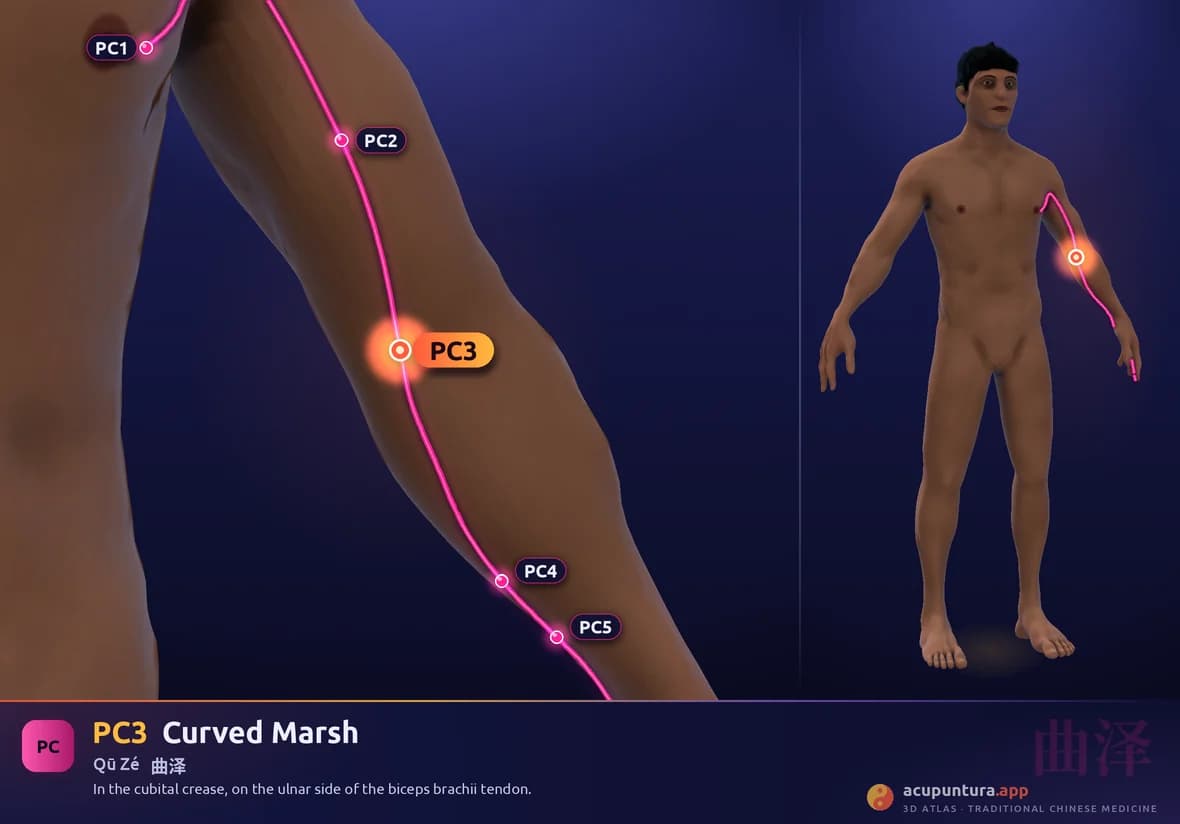
Pericardium Channel
Curved Marsh
曲泽Qū ZéAnatomical location
In the cubital crease, on the ulnar side of the biceps brachii tendon.
Main function
Regulates Heart Qi, cools the Blood, calms the Shen.
- He-Sea point (Water)
Therapeutic indications
- Chest pain
- palpitations
- vomiting
- fever
- acute gastroenteritis
- high fever
- hand tremor
- elbow pain
- heatstroke
- intense thirst
- irritability
Name and classical tradition
Quze, 曲澤, is the “marsh at the bend.” 曲 means curved, bent; 澤 is the marsh, the low ground where water pools. The classical text itself explains the first half of the name: the Lingshu (Spiritual Pivot), Ben Shu (本輸) chapter, says «入於曲澤,曲澤,肘內廉下陷者之中也,屈而得之,為合». The Qi enters Quze, in the depression on the medial edge of the elbow; it is found with the elbow flexed; it is the He-Sea point. The «屈而得之» explains the 曲 in the name.
As the He-Sea point (合穴) of a yin channel, it corresponds to Water, and the image of the marsh fits this place where the Qi of the channel gathers before going deep. Modern manuals develop the metaphor by speaking of the heat of the channel cooling and condensing here, but that is a gloss with no citation. The parallel with LU5, Chize, the “elbow pool” of the Lung and also a He-Sea point at the flexure, is obvious.
The Ben Shu passage ends with a sentence of historical interest: «手心主經也», this is the Heart Master channel. The oldest text does not yet speak of the Pericardium (心包) but of the “lord” or “master” of the heart, the one who acts on its behalf. The underlying doctrine is that the Heart, as sovereign, is not needled directly, and its function is exercised through this delegated channel.