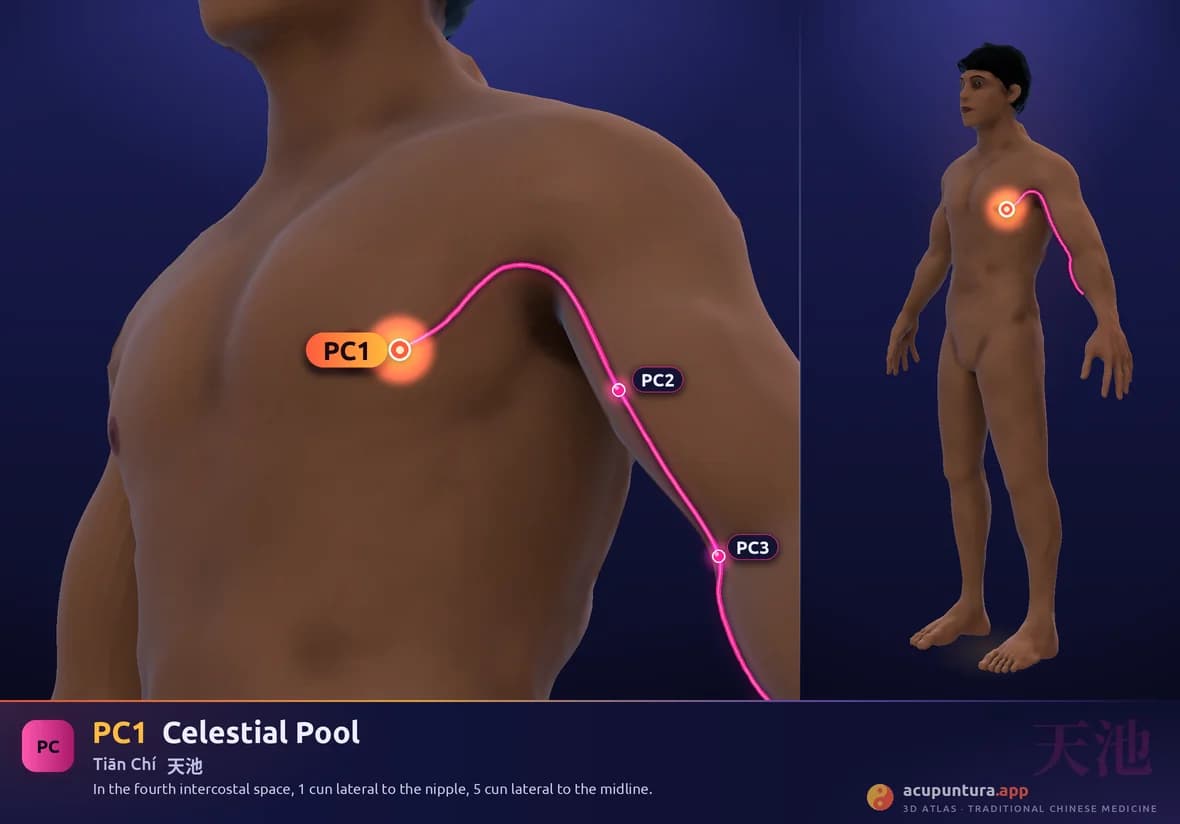
Pericardium Channel
Celestial Pool
天池Tiān ChíAnatomical location
In the fourth intercostal space, 1 cun lateral to the nipple, 5 cun lateral to the midline.
Main function
Regulates Heart Qi, relieves chest pain, calms the Shen.
- Crossing point with the Liver
Therapeutic indications
- Chest pain
- chest tightness
- cough
- palpitations
- chest fullness
- mastitis
- scanty lactation
- axillary scrofula
- hypochondriac pain
- sensation of oppression
Name and classical tradition
Tianchi, 天池, the “heavenly pool,” is the point where the Pericardium channel surfaces on the chest, beside the nipple. 天 here designates the upper part of the trunk; 池 is a pool, a receptacle for water. With PC2, the “heavenly spring,” it forms a small pair of water names at the top of the channel.
The earliest mention is in the Lingshu (Spiritual Pivot), Ben Shu (本輸) chapter, in a passage that lists points of the neck and axilla: «腋下三寸,手心主也,名曰天池», three cun below the axilla, on the hand Heart Master channel (the Pericardium channel), is the point called Tianchi. The same passage names LU3, Tianfu, a little earlier with the identical formula. It is a direct quotation, although it comes from aggregator sources and should be checked against a printed edition.
The explanation of the name that circulates in modern manuals is physiological: the warm Qi that leaves CV17, Danzhong, the Front-Mu point of the Pericardium, would arrive here, cool down, and condense like rain falling from the sky into a pool. It is a school interpretation with no classical support. What the Zhenjiu Jiayi Jing (Systematic Classic of Acupuncture and Moxibustion) does contain is its alternative name and its status as a crossing point: «天池,一名天會…手厥陰足少陽脈之會», Tianchi, also called Tianhui, “heavenly meeting,” is a meeting point of the hand Jueyin and the foot Shaoyang.
In the Ming period, a mnemonic poem collected in the Zhenjiu Dacheng (Great Compendium of Acupuncture and Moxibustion) runs through the nine points of the channel starting at the fingertip and ends precisely here: «酌天泉於天池», take the water of Tianquan at Tianchi.
Other names
- 天會Jiayi Jing