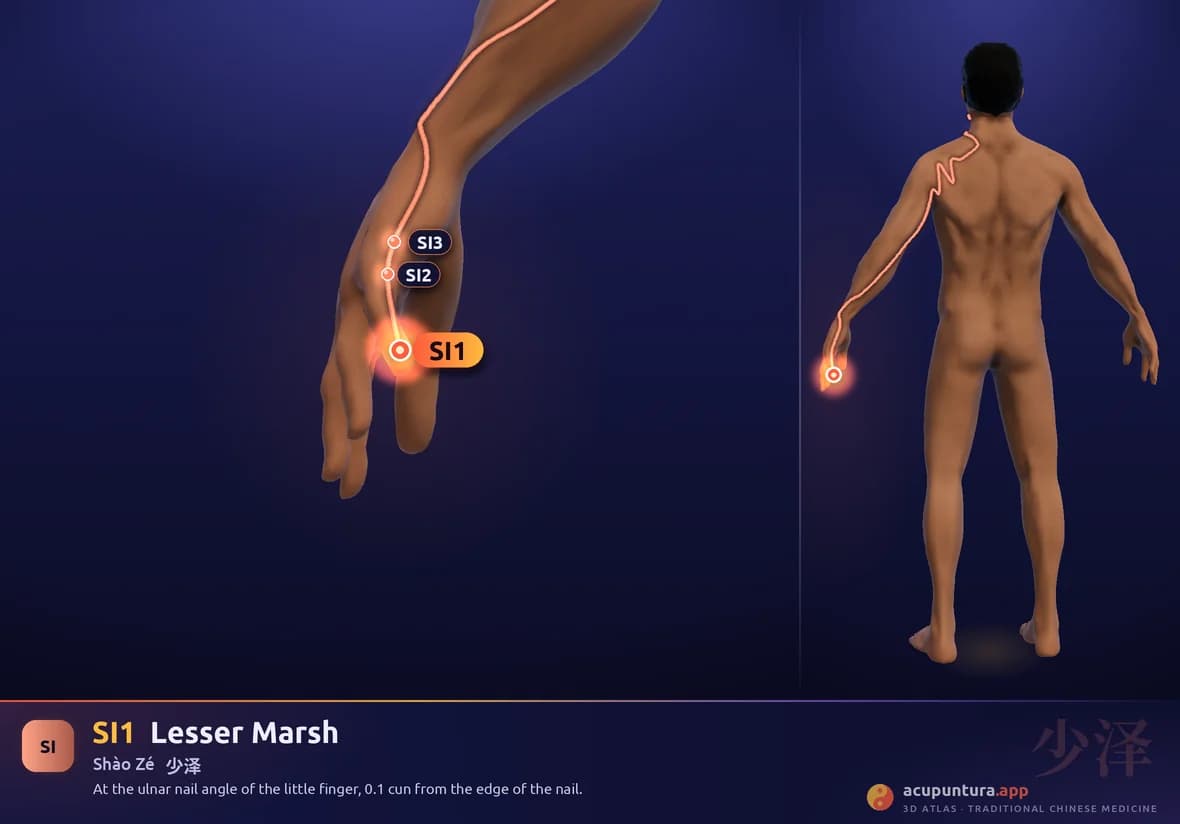
Small Intestine Channel
Lesser Marsh
少泽Shào ZéAnatomical location
At the ulnar nail angle of the little finger, 0.1 cun from the edge of the nail.
Main function
Clears Heat, promotes lactation, benefits the ears.
- Jing-Well point (Metal)
Therapeutic indications
- Sore throat
- fever
- tinnitus
- mastitis
- loss of consciousness
- Scanty lactation
- Loss of consciousness
- Stiff tongue
- Corneal opacity
- Headache
- Numbness of the little finger
- High fever
Name and classical tradition
Shaoze, 少泽, is the “small marsh.” 少 means small or scarce, and also Yin; 泽 (澤) is the marsh, wet ground. The point opens the Small Intestine channel at the tip of the little finger, on the outer side, and modern manuals explain the name with the image of Qi emerging here like the damp mist of a marsh. Another reading takes 澤 as “to moisten” and links it to the function that theory assigns to the Small Intestine of governing fluids (主液). Neither reading has a classical citation.
The ancient reference is the Lingshu (Spiritual Pivot), in the Ben Shu chapter (本輸), which includes it in the sequence of the five transport points of the channel, although the literal quotation has not been recovered. As a Jing-Well point (井穴) of a Yang channel, it corresponds to Metal. Reference works give it the alternative name 少吉.
The 澤 in the name is the same one found in LU5, Chize, and PC3, Quze, the “marshes” of the elbow, even though here it appears at the end of the finger rather than in a crease, and with the adjective 少 that makes it small.
Other names
- 小吉Jiayi Jing