Small Intestine Channel
Celestial Ancestor
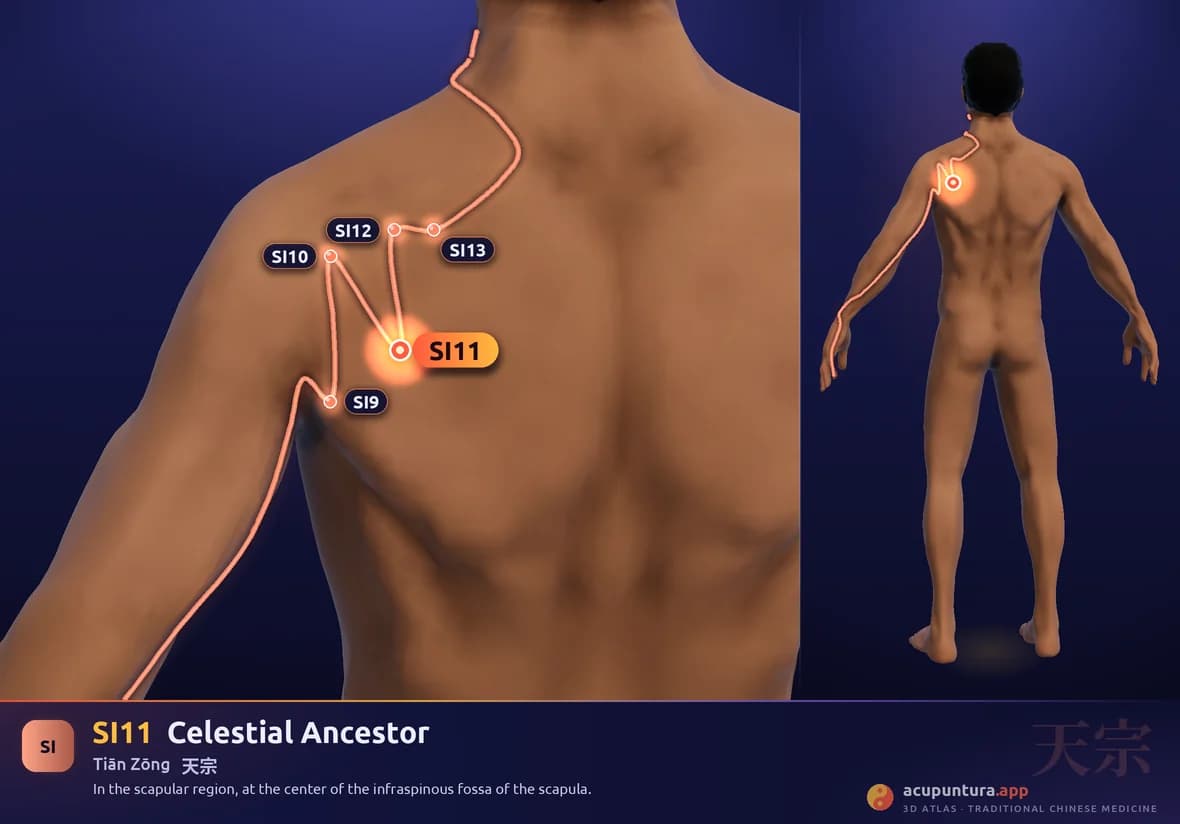
天宗Tiān ZōngAnatomical location
In the scapular region, at the center of the infraspinous fossa of the scapula.
Main function
Relieves scapular and shoulder pain, promotes lactation.
Therapeutic indications
- Scapular pain
- shoulder pain
- mastitis
- insufficient lactation
- Scapulohumeral periarthritis
- Elbow pain
- Asthma
- Costal pain
Name and classical tradition
Tianzong, 天宗, is the “ancestor of Heaven” or the “celestial temple.” 天 is Heaven; 宗, the ancestral temple, what is venerated, and also to present oneself before someone. The point lies at the center of the infraspinous fossa of the shoulder blade, and its name belongs to a small celestial set. With its neighbors, SI12, Bingfeng, “the one who holds the wind,” and SI13, Quyuan, “the curved wall,” it traces on the shoulder blade a configuration reminiscent of those in Chinese astronomy: Tianzong in the center, surrounded by a wall and by the wind. The reference works also mention a Tianzong bone (天宗骨), an old name for a prominence of the scapula. This is the best-founded reading. Another, an energetic and modern one, speaks of Qi rising and gathering in the upper part of the body like someone presenting themselves at the temple.
The Zhenjiu Jiayi Jing (Systematic Classic of Acupuncture and Moxibustion) gives its location in relation to its neighbor: “天宗在秉风后,大骨下陷者中,” Tianzong is behind Bingfeng, in the depression below the large bone, the spine of the scapula. And it attributes to it “肩重,肘臂痛,不可举,” a heavy shoulder and pain in the elbow and arm that prevents lifting it. The Xunjing Kaoxue Bian and Gao Shishi’s Suwen Zhijie, in the Qing period, record variants of its measurement.
In modern practice the point has become famous for its use in breast conditions. This is a clinical development of the 20th and 21st centuries, not an ancient tradition.