Small Intestine Channel
Curved Wall
曲垣Qū YuánAnatomical location
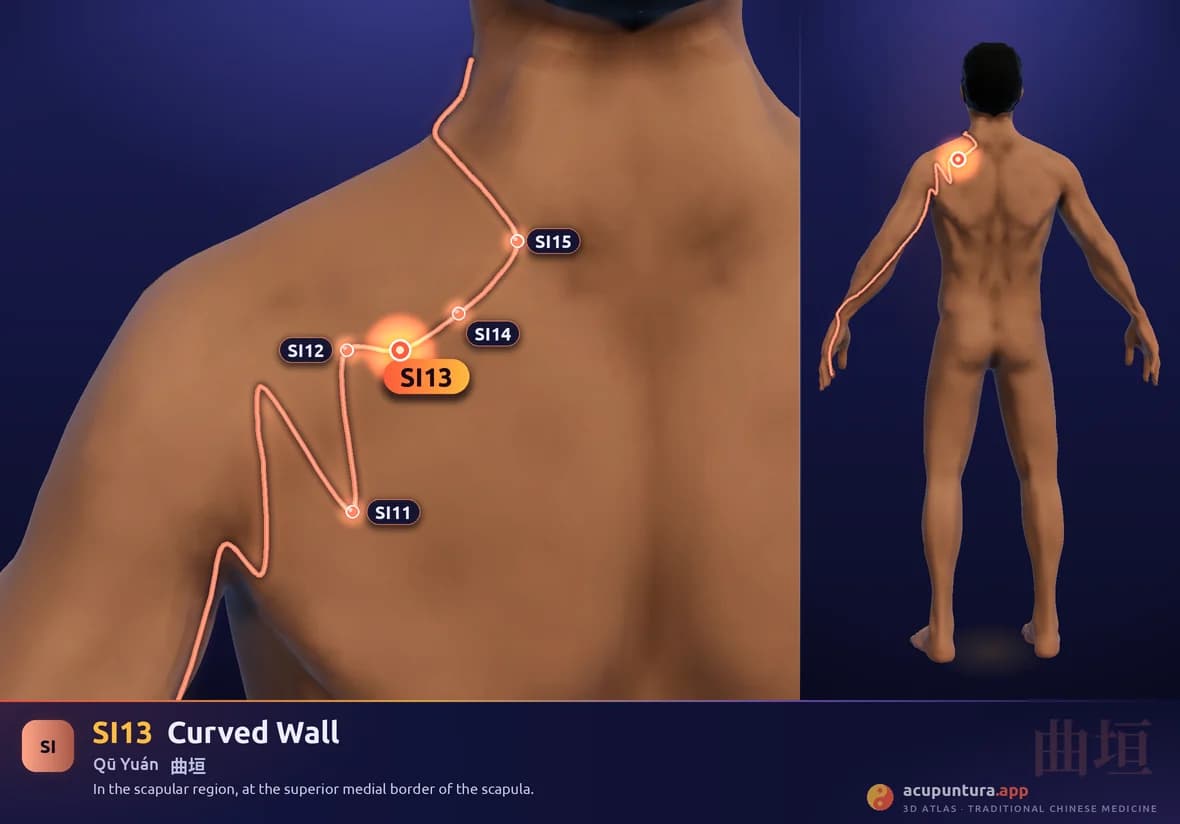
In the scapular region, at the superior medial border of the scapula.
Main function
Relieves scapular and shoulder pain, dispels Wind-Dampness.
Therapeutic indications
- Scapular pain
- shoulder pain
- neck stiffness
- Scapular pain and stiffness
- Shoulder contracture
- Upper back pain
Name and classical tradition
Quyuan, 曲垣, is the “curved wall.” 曲 is curved; 垣, the low wall, the garden wall. The spine of the scapula curves like a wall, and the point lies at its medial end. This is the morphological reading, the most solid and the most consistent with the set of shoulder blade names, in which SI11 is the celestial center and SI12 the wind. In Chinese astronomy, 垣 is also the name of the “enclosures” that bounded regions of the sky, which reinforces the reading of the set as a whole, although no ancient source expressly links it to the point.
A modern gloss circulates that reads 曲 as “hidden” and sees in the wall a mound of earth dust deposited by Qi. This is a strained reading, and there is no reason to prefer it to the anatomical one. The oldest known record is that of the Zhenjiu Jiayi Jing (Systematic Classic of Acupuncture and Moxibustion).