Small Intestine Channel
Shu Point of the Arm
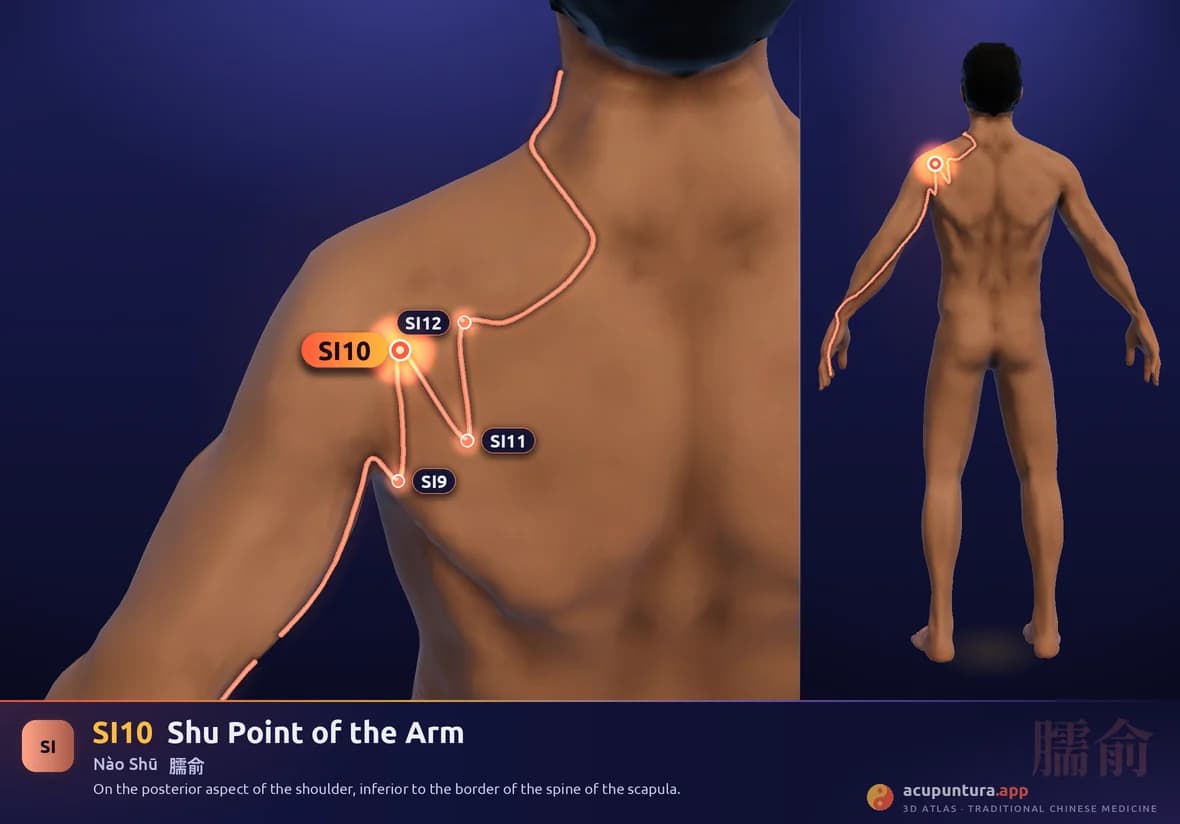
臑俞Nào ShūAnatomical location
On the posterior aspect of the shoulder, inferior to the border of the spine of the scapula.
Main function
Relieves shoulder and arm pain, dispels Wind-Dampness.
- Crossing point with the Yang Wei Mai
Therapeutic indications
- Shoulder pain
- shoulder stiffness
- scapular pain
- Shoulder weakness
- Inability to raise the arm
- Shoulder swelling
Name and classical tradition
Naoshu, 臑俞, is the “transport point of the arm.” 臑 designates the upper arm, the region of the deltoid, and in ancient texts also the foreleg of an animal; 俞, the transport point, the place where Qi gathers and is transmitted. It is a simple descriptive name with little room for interpretive risk, similar to that of LI14, Binao, which uses the same 臑.
The first work to record it is the Zhenjiu Jiayi Jing (Systematic Classic of Acupuncture and Moxibustion). Its most relevant doctrinal feature is that it is a crossing point of the channel with two Extraordinary Vessels, the Yang Wei Mai and the Yang Qiao Mai, something the sources report consistently.