Small Intestine Channel
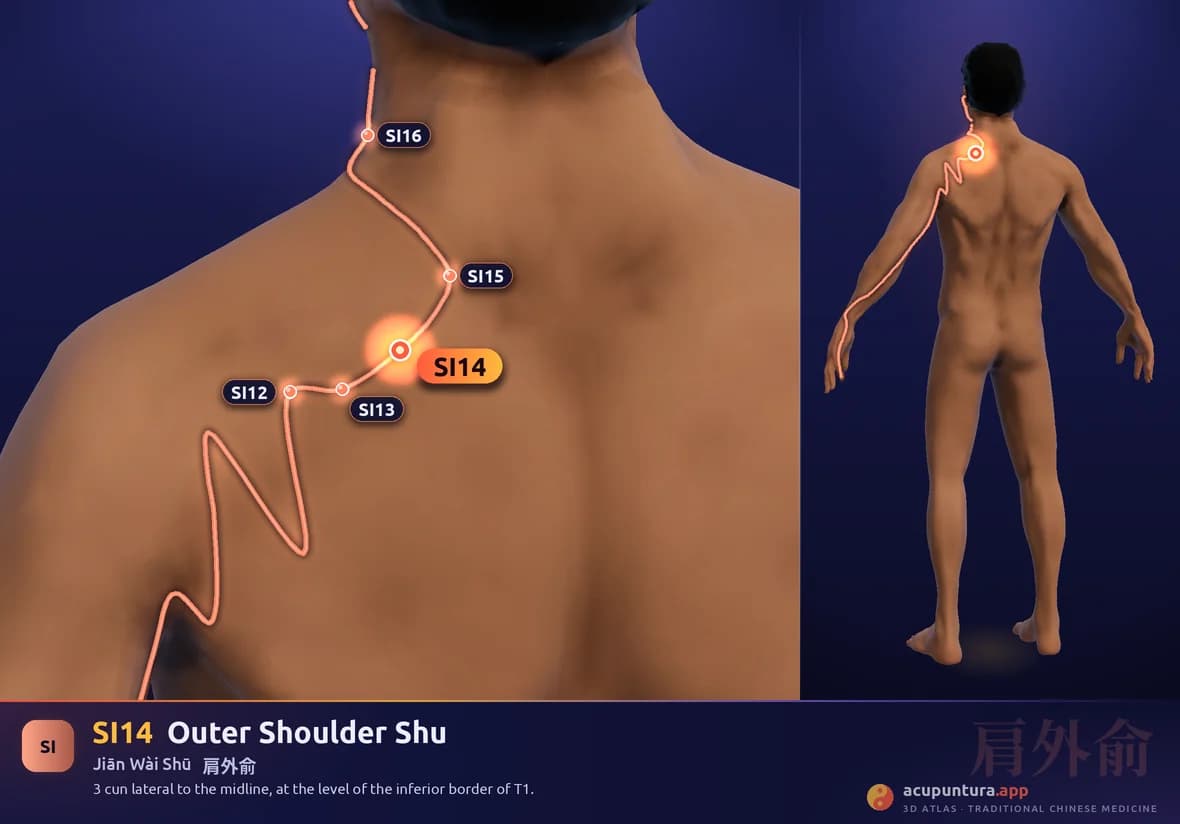
Outer Shoulder Shu
肩外俞Jiān Wài ShūAnatomical location
3 cun lateral to the midline, at the level of the inferior border of T1.
Main function
Relieves scapular and shoulder pain, dispels Wind-Dampness.
Therapeutic indications
- Shoulder pain
- scapular pain
- neck stiffness
- Shoulder and back pain
- Cervical stiffness
- Contracture between the shoulder blades
- Sensation of cold in the back
Name and classical tradition
Jianwaishu, 肩外俞, is the “outer transport point of the shoulder.” 肩 is the shoulder, the scapula; 外, the outer, the farthest from the spine; 俞, the transport point. The name is not understood on its own but by contrast with that of its neighbor, SI15, Jianzhongshu, the “central” point: the two form a pair ordered by distance from the vertebral column. Naming by opposition is a very common device in nomenclature and requires no strained interpretation.
The first work to record it is the Zhenjiu Jiayi Jing (Systematic Classic of Acupuncture and Moxibustion). It has no known alternative names and no classical commentaries.