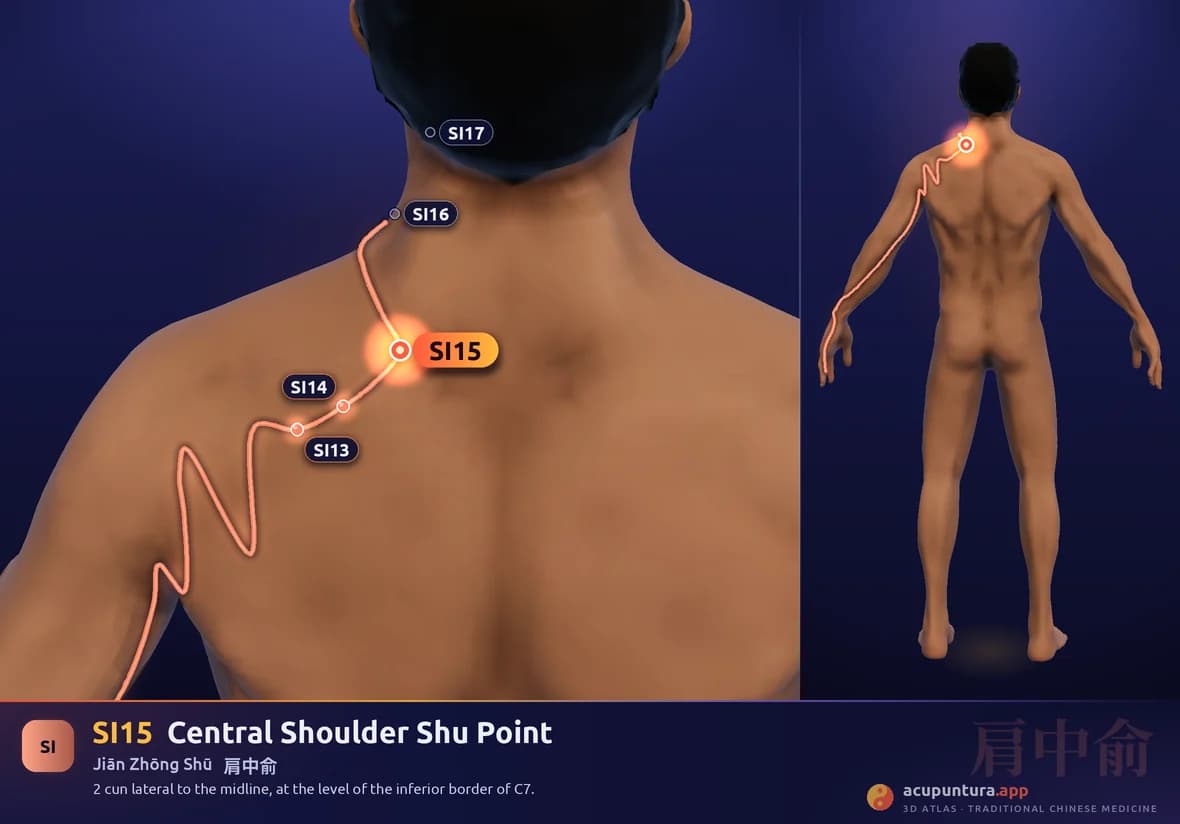
Small Intestine Channel
Central Shoulder Shu Point
肩中俞Jiān Zhōng ShūAnatomical location
2 cun lateral to the midline, at the level of the inferior border of C7.
Main function
Relieves scapular and shoulder pain, benefits the Lungs.
Therapeutic indications
- Shoulder pain
- cough
- asthma
- neck stiffness
- Shoulder and back pain
- Blurred vision
- Hemoptysis
Name and classical tradition
Jianzhongshu, 肩中俞, is the “central transport point of the shoulder.” It forms a pair with SI14, Jianwaishu: where that one is outer, 外, this one is central, 中, closer to the spine. The two names mark their relative position with respect to the medial border of the shoulder blade and the line of the vertebrae, and they are understood together, like so many other pairs in classical nomenclature, from LI8 and LI9 to ST37 and ST39.
It is a descriptive name of high reliability. The first work to record it is the Zhenjiu Jiayi Jing (Systematic Classic of Acupuncture and Moxibustion), and no aliases or ancient commentaries are known for it. With this point, the channel leaves the shoulder and rises to the neck.