Small Intestine Channel
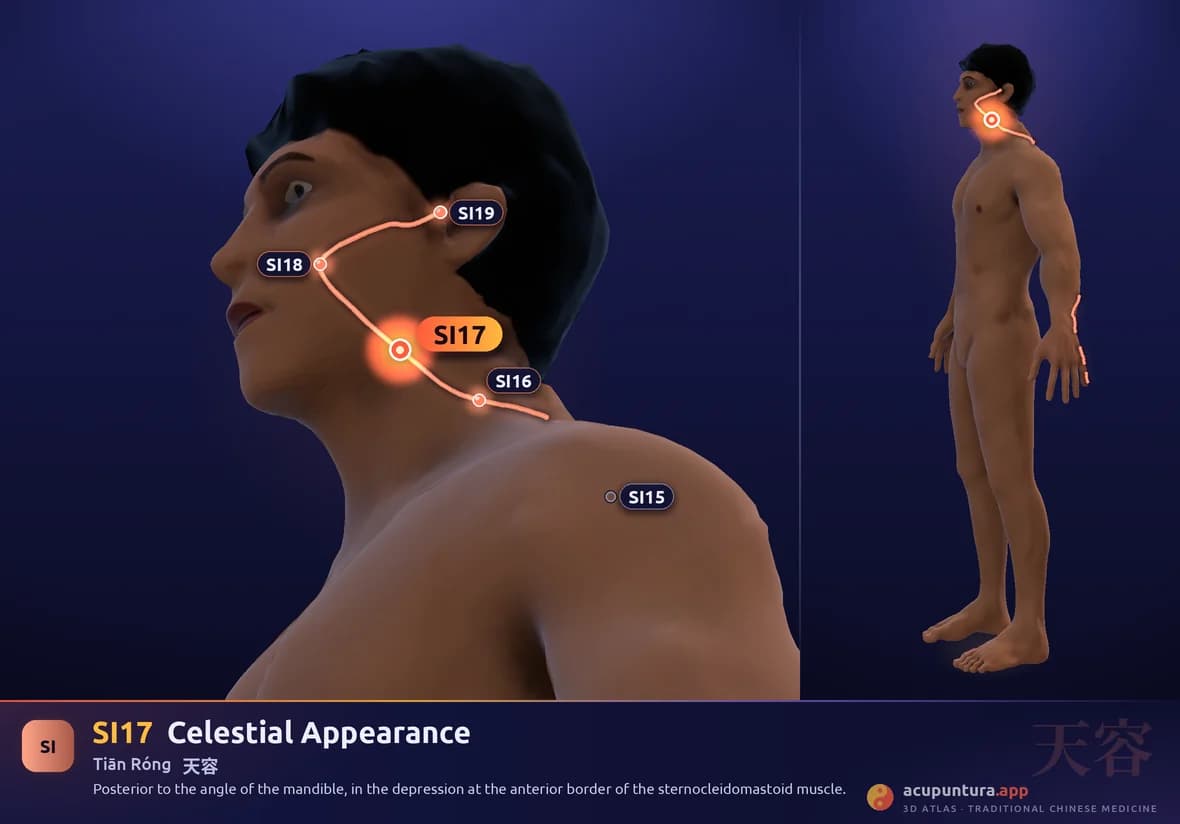
Celestial Appearance
天容Tiān RóngAnatomical location
Posterior to the angle of the mandible, in the depression at the anterior border of the sternocleidomastoid muscle.
Main function
Benefits the ears, clears Heat, relieves neck pain.
- Window of Heaven point
- Crossing Point with the Gallbladder
Therapeutic indications
- Tinnitus
- deafness
- sore throat
- facial paralysis
- Goiter
- Scrofula
- Difficulty swallowing
- Cervical stiffness
- Sensation of a lump in the throat
- Hypothyroidism
- Hyperthyroidism
Name and classical tradition
Tianrong, 天容, is a name that is hard to interpret. 天 is the upper part; 容 can mean to contain or to hold, or else appearance or look. A modern gloss understands that the damp Qi rising from SI16 cools here and is held like a cloud. Another, less convincing, reads 容 as the helmet, and would place the point where the lower edge of a helmet would hang. Neither has classical support, and there is no consensus between them.
Secondary sources trace it to the Lingshu (Spiritual Pivot) without specifying the chapter. It cannot be the Ben Shu in its section on the points of the arm, so the exact attribution remains to be verified. It is, all the same, one of the points of the channel whose name is least well understood.