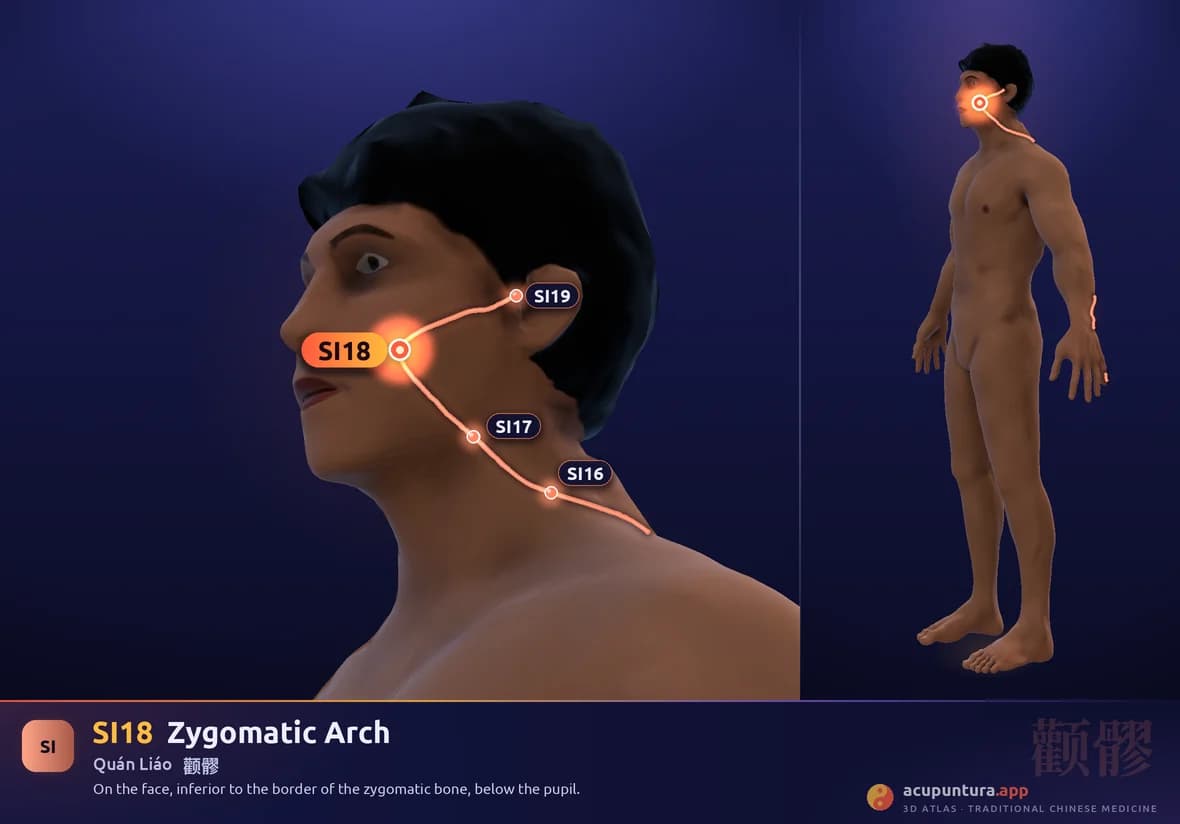
Small Intestine Channel
Zygomatic Arch
颧髎Quán LiáoAnatomical location
On the face, directly below the outer canthus of the eye, in the depression at the lower border of the zygomatic bone.
Main function
Relieves facial pain, treats facial paralysis, clears Heat.
- Crossing Point with the Triple Energizer
Therapeutic indications
- Facial paralysis
- facial spasm
- toothache
- headache
- Facial tic
- Trigeminal neuralgia
- Cheek swelling
- Jaundice
Name and classical tradition
Quanliao, 颧髎, is the “cleft of the cheekbone.” 颧 (顴) is the cheekbone, the zygomatic bone; 髎, the hollow next to the bone. The name is anatomical: the point lies in the depression below the cheekbone. It shares the 髎 with other points of the face, like ST3, Juliao, or LI19, Heliao.
The first work to record it is the Zhenjiu Jiayi Jing (Systematic Classic of Acupuncture and Moxibustion). Sun Simiao’s Beiji Qianjin Yaofang, in the Tang period, writes it 權髎, with 權 in place of 顴, two characters related in sound and in form. It is a variant attributed to a specific work and author, although the citation has not been verified. The reference works also give it the alternative name 兌骨, which should not be confused with the name the Nanjing (Classic of Difficulties) gives to HT7, Shenmen, at the wrist.
Other names
- 兌骨Jiayi Jing