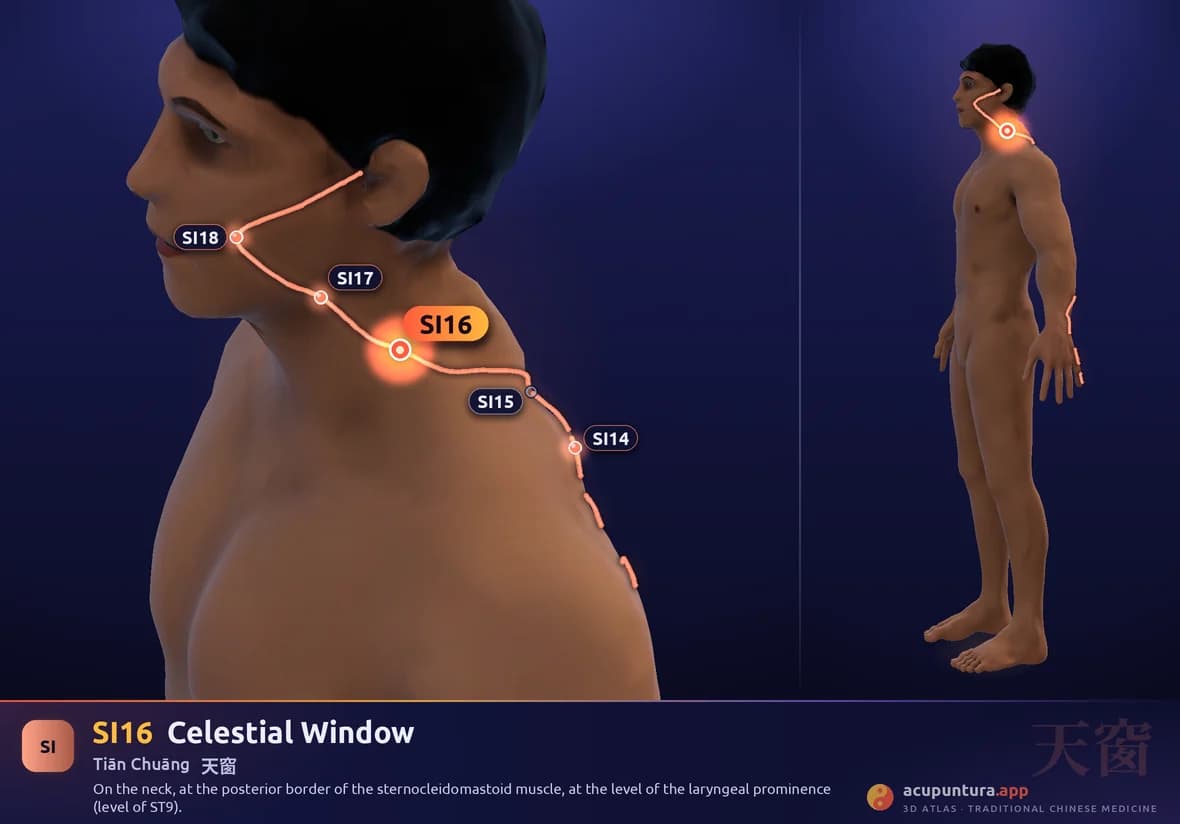
Small Intestine Channel
Celestial Window
天窗Tiān ChuāngAnatomical location
On the neck, at the posterior border of the sternocleidomastoid muscle, at the level of the laryngeal prominence (level of ST9).
Main function
Benefits the ears, clears Heat, relieves neck pain.
- Crossing Point with the Gallbladder
Therapeutic indications
- Tinnitus
- deafness
- sore throat
- neck pain
- Sudden deafness
- Nape stiffness
- Aphonia
- Scrofula
Name and classical tradition
Tianchuang, 天窗, is the “window of Heaven.” 天 indicates the upper part of the body, here the neck; 窗, the window. The point treats ear disorders, and the usual reading describes it as a window that opens toward the auditory orifice. Its name is one of the many on the neck and head that combine 天 with an architectural or natural element, like SI17, Tianrong, or ST16, Yingchuang, the window of the chest.
The textual origin is the Suwen (Basic Questions), in the chapter Qi Xue Lun (氣穴論). The first of its alternative names is already in the Zhenjiu Jiayi Jing (Systematic Classic of Acupuncture and Moxibustion), “天窗,一名窗籠,” and the others reinforce the image of the window: 窗簧 and 天籠. 籠 and 簧 designate mechanisms that open and close, like a blind or a spring. There is also the written form 窗聾, with 聾, “deafness,” a homophone of 籠. Whether the coincidence was deliberate, a play between the window and the deafness the point treats, is a suggestive observation, but no ancient source confirms it.
Other names
- 窗籠Jiayi Jing