Small Intestine Channel
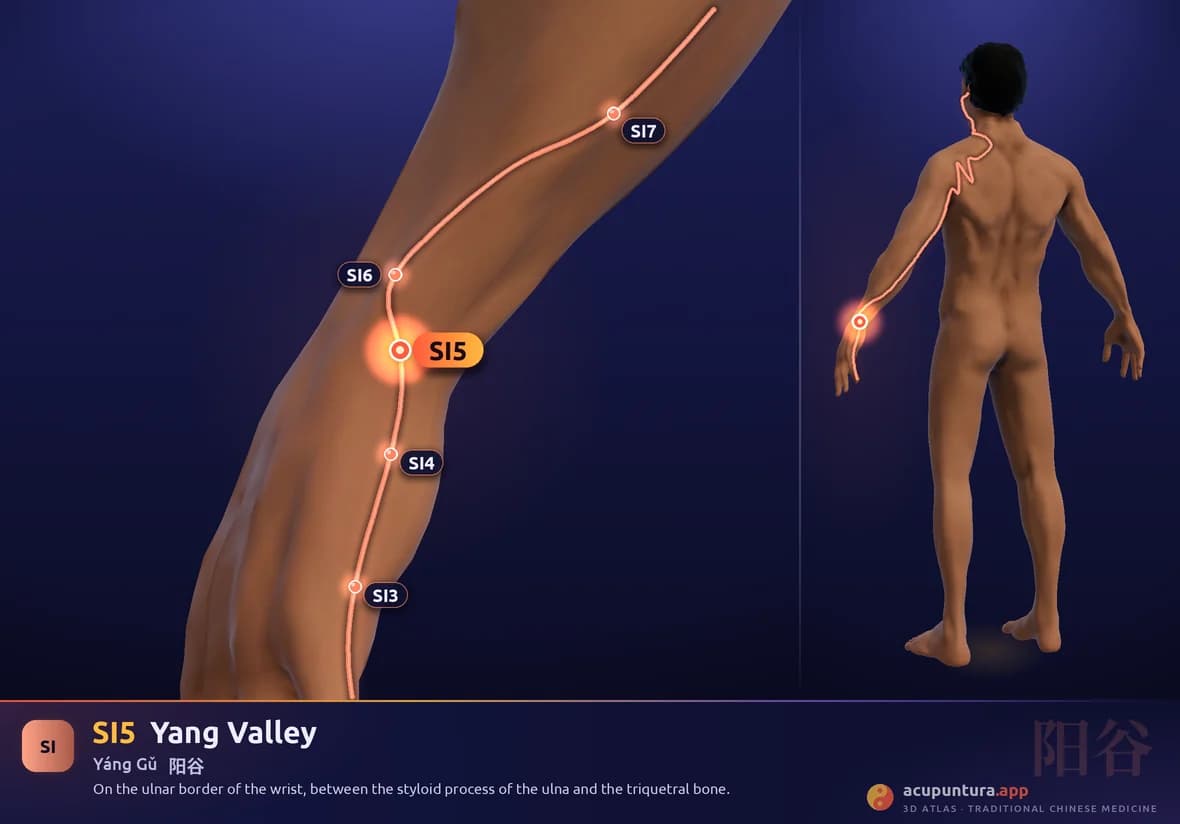
Yang Valley
阳谷Yáng GǔAnatomical location
On the ulnar border of the wrist, between the styloid process of the ulna and the triquetral bone.
Main function
Clears Heat, benefits the ears and eyes, calms the Shen.
- Jing-River point (Fire)
- Ryodoraku point H4 (Small Intestine)
Therapeutic indications
- Tinnitus
- deafness
- headache
- insomnia
- wrist pain
- Wrist pain
- Pain on the side of the neck and jaw
- Mania
- Infantile convulsions
- Toothache
- Fever
Ryodoraku
H4Intestino DelgadoMeasurement point no. 6
Jing-River point, not the Yuan-Source point (SI4). It is Nakatani's representative point.
Name and classical tradition
Yanggu, 阳谷, is the “valley of Yang.” 阳 (陽) is Yang, the outer side of the forearm and hand; 谷, the valley, is the cleft between bony prominences. A description recorded in the sources explains it all in a few words: “位于手外侧腕中,兑骨下陷处,因外为阳,故名阳谷.” It is on the wrist, on the outer side of the hand, in the depression below the pointed bone; because the outer side is Yang, it is called “valley of Yang.” The bone is the styloid process of the ulna. The phrase seems to be of classical or semi-classical origin, but the work has not been identified, and it should not be treated as a quotation from the Lingshu (Spiritual Pivot).
The Lingshu, in the Ben Shu chapter (本輸), records it as the Jing-River point (經穴) of the channel, which on the Yang channels corresponds to Fire. Its neighbor LI5, Yangxi, the “Yang stream” of the Large Intestine, lies on the opposite side of the same wrist and is named with the same logic.