Small Intestine Channel
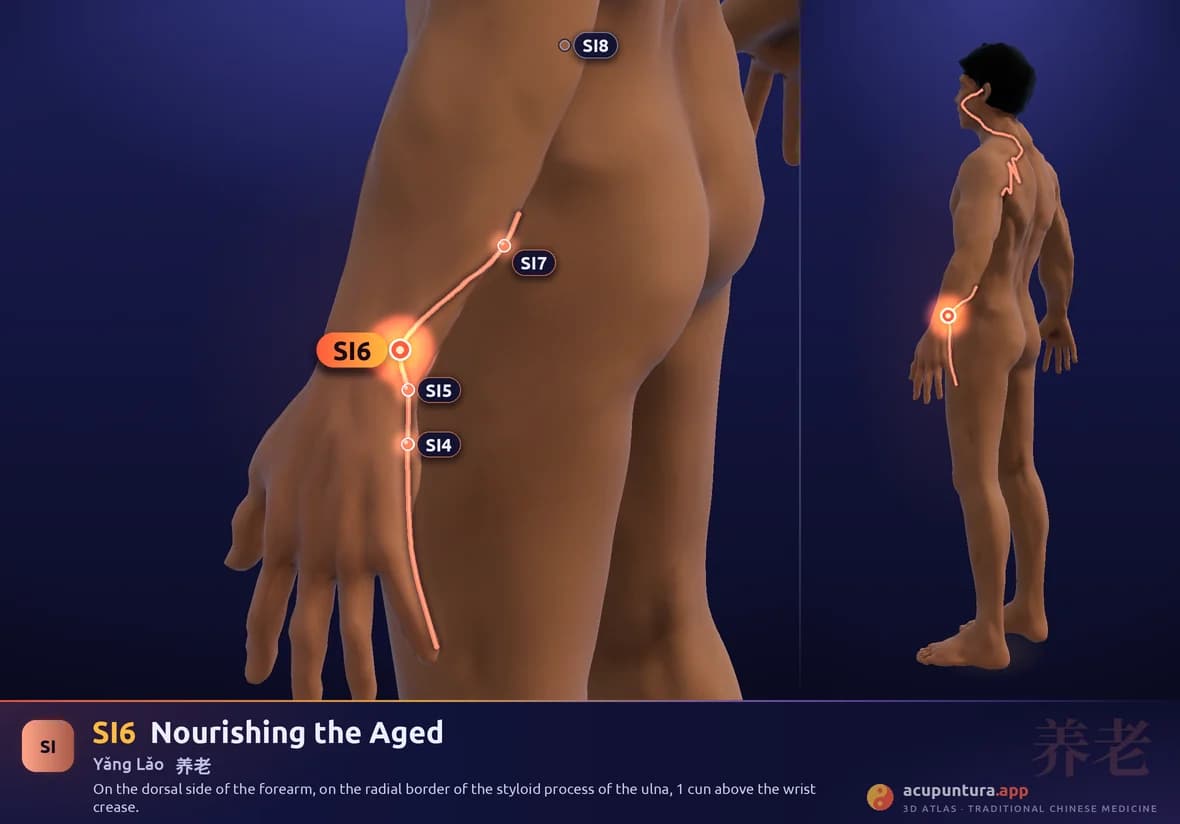
Nourishing the Aged
养老Yǎng LǎoAnatomical location
On the dorsal side of the forearm, on the radial border of the styloid process of the ulna, 1 cun above the wrist crease.
Main function
Benefits vision, relieves shoulder and arm pain.
- Xi-Cleft point
Therapeutic indications
- Blurred vision
- eye pain
- shoulder pain
- headache
- Shoulder and arm pain
- Acute low back pain
- Stiffness of the wrist
- Hemiplegia
- Difficulty turning the neck
Name and classical tradition
Yanglao, 养老, means “nourishing old age.” 养 (養) is to feed, to care for; 老, the elderly. Unlike its neighbors, whose names describe bones, valleys, or streams, this name is therapeutic: it says what the point is for. The tradition has used it for ailments typical of age, such as tired eyes (目花), deafness (耳聾), aching low back (腰痠), or heaviness of the body (身重).
It is also distinct in its origin. Most of the distal points of the channel appear in the Ben Shu chapter of the Lingshu (Spiritual Pivot), but Yanglao is first recorded in the Zhenjiu Jiayi Jing (Systematic Classic of Acupuncture and Moxibustion) by Huangfu Mi, in the 3rd century. It is the Xi-Cleft point (郄穴) of the Small Intestine, the deep accumulation point that the tradition uses in acute conditions. It has left no aliases or glosses from ancient commentators.