Small Intestine Channel
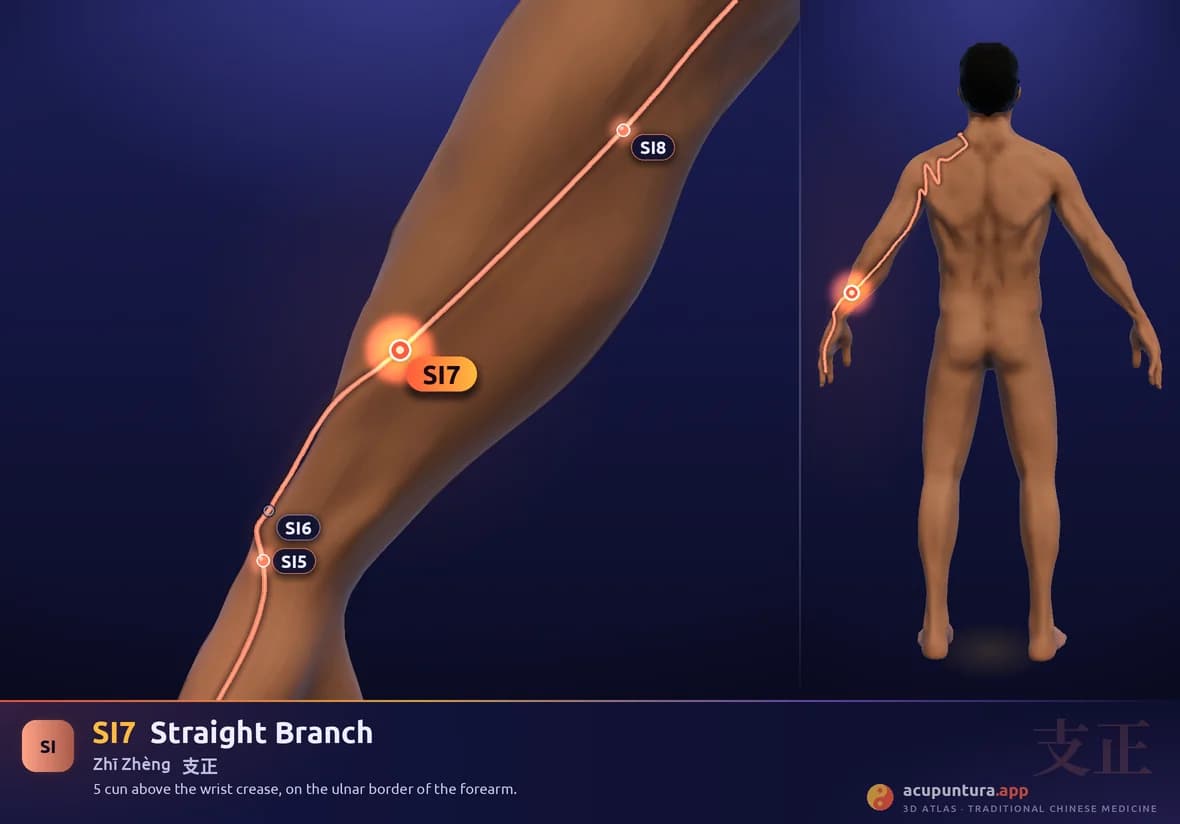
Straight Branch
支正Zhī ZhèngAnatomical location
5 cun above the wrist crease, on the ulnar border of the forearm.
Main function
Calms the Shen, clears Heat, relieves arm pain.
- Luo (Connecting) point
Therapeutic indications
- Headache
- blurred vision
- arm pain
- insomnia
- Stiff neck
- Pain in the elbow and fingers
- Mania
- Anxiety
- Warts
- Fever
Name and classical tradition
Zhizheng, 支正, is the Luo-Connecting point (絡穴) of the Small Intestine, and the Lingshu (Spiritual Pivot) records it in the Jing Mai chapter (經脈), the one that describes the collaterals of the channels. A branch separates from it and goes to the coupled channel, that of the Heart.
The name admits several readings. The one most consistent with that function takes 支 as the branch, the deviation, and 正 as the main channel: the point would be the place where the branch departs from the straight trunk. Another reading understands 支 as alluding to the lesser part of the flow and 正 to the greater part, which continues straight along the channel. A third takes 支 as a phonetic loan for 肢, “limb,” and 正 as “center,” because the point is at the midpoint of the forearm. All three are glosses without a classical citation; the first is the one that best fits the doctrine of the collaterals. Its counterpart on the Heart channel, the Luo that runs in the opposite direction, is HT5, Tongli.